
The End of the Execution Army: Why Marketing Agencies Must Rewrite Their Contracts for the AI Era

EXECUTIVE OVERVIEW
The intelligence and automation revolution has swept through the marketing landscape, forcing an unprecedented, structural transformation across agencies of every discipline—media, creative, performance, brand, measurement, CRM, advocacy, auditing, and hybrid full-service models. For decades, the agency-client relationship was anchored on a straightforward, if inefficient, premise: human labor traded for ad-touching tasks. Account managers built campaigns, manually adjusted keywords, sculpted audience lists, paced budgets, and generated sprawling reports to prove their ongoing value.
That world is gone. Today, autonomous platforms, machine-learning bid algorithms, and generative AI engines execute these granular tasks with a scale, speed, and precision that human teams simply cannot match. Yet, despite this technological leap, the vast majority of marketing contracts remain tethered to the past. Bound by outdated Statements of Work (SOWs) and toxic "Percent of Media Spend" compensation models, modern brands are paying agencies to perform manual tasks that actively sabotage AI-led algorithms.
According to strategic industry frameworks, brands that fail to renegotiate their agency contracts face paying a heavy tax for obsolescence. Conversely, organizations willing to dismantle legacy frameworks can unlock monumental efficiency gains: an immediate 25% to 75% reduction in baseline agency fees starting in July 2026, paired with targeted reinvestments into high-level strategy, governance, and creative conceptualization. This shift is not merely a cost-cutting exercise; it is an existential realignment designed to trade the "hamster wheel" of manual execution for high-impact, outcome-driven partnerships.
DETAILED CHRONOLOGY: THE SHIFT FROM LABOR TO ALGORITHM
To understand how the marketing industry arrived at this precipice, one must examine the systematic mechanization of digital advertising over the past several years.
Phase 1: The Mechanization of Performance (2022–2024)
The initial tremors of the automation revolution were felt in performance marketing. Platforms rolled out advanced automated campaign structures—such as Google’s Performance Max (PMax), Meta’s Advantage+ (A+), and Amazon’s AI-driven ad suites. These systems consolidated hundreds of granular, manually curated keyword lists and sliced-and-diced audience segments into unified asset groups.
Instead of welcoming this efficiency, many traditional agencies fought it. Fearing that automated platforms would erode billable hours, agency teams frequently "over-touched" campaigns—tweaking bids, resetting learning phases, and introducing minor adjustments disguised as micro-optimizations. In doing so, they sabotaged the algorithms, creating artificial volatility that required constant human intervention.
Phase 2: The Collapse of the Execution Army (2025)
By mid-2025, the realization that "we are not in Kansas anymore" settled into boardrooms. Brands recognized that platform intelligence could manage bids, day-parting, device modifiers, and daily pacing infinitely better than human armies. The core justification for heavy agency retainers—manual execution—evaporated.
This technological displacement exposed a fundamental misalignment in legacy contracts. SOWs that rewarded manual optimization, complex campaign setups, and high media spend incentivized agencies to resist AI adoption. The economic incentive structure was inverted: the harder the agency worked on outdated tasks, the more it damaged campaign performance, and the more the client paid.
Phase 3: The 2026 Reckoning and Contractual Overhaul
As the industry looks toward July 2026, the mandate is clear: contracts must be systematically dismantled and rebuilt. The reduction in redundant work listed in legacy agency SOWs will translate into massive fee savings. However, these savings are not designed to pad corporate bottom lines; they are intended to fund new, underpowered strategic functions that are critical today and will be existential by 2027.
SUPPORTING CONTEXT & METRICS: DECONSTRUCTING THE AGENCY SOW
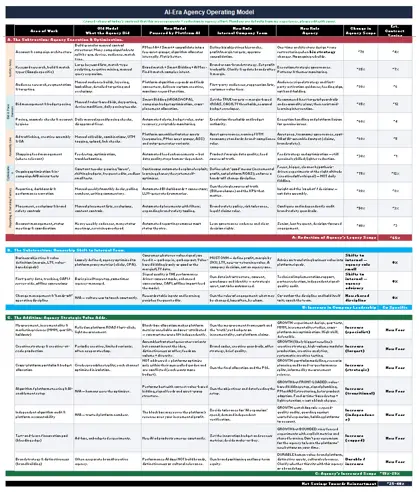
To execute a successful contract renegotiation, marketing leaders must separate legacy operational tasks into distinct cost centers, evaluate their vulnerability to AI automation, and ruthlessly trim the fat. A granular analysis of typical agency contracts reveals five major operational clusters ripe for structural reduction.
1. The Agency Activity Army
- Old Model: Account and campaign architecture, keyword research, match-type sculpting, audience segmentation, and radio/TV ad tactic structuring. Agencies maintained hundreds of thinly sliced campaigns "for control."
- New Model: Machines ingest intent across tens of thousands of data points. Platforms like PMax and Advantage+ collapse structures into automated asset groups. The agency’s role is reduced to one-time architecture design and high-level strategy setting.
- Cost Weight: ~22% of total contract cost.
- Potential Reduction: ~78%.
2. The Bid & Pace Dancers
- Old Model: Manual bidding, budget adjustments, day-parting, device modifiers, daily pacing, spend checks, and anomaly resolution. Hours of human labor dedicated to operational hygiene.
- New Model: Smart bidding engines optimize continuously against defined reward functions. Human intervention often resets the machine’s learning cycle, degrading performance.
- Cost Weight: ~14% of total contract cost.
- Potential Reduction: ~73%.
3. The Assembly Line
- Old Model: Trafficking, ad builds, variant creation, tagging, QA, and shopping-feed management.
- New Model: Ad platforms leverage generative AI to mix images, video, audio, and text into dynamic formats tailored to individual users in real time. Human roles narrow to asset preparation, taxonomy management, and feed maintenance.
- Cost Weight: ~12% of total contract cost.
- Potential Reduction: ~45%.
4. The Optimization Theater
- Old Model: Daily rituals of pausing underperforming ads, shifting budgets by "gut feel," and running unfocused A/B testing agendas.
- New Model: Modern AI platforms run continuous explore-exploit cycles at superhuman speeds, accounting for learning curves spanning weeks or months. Human agency focus shifts to massive, high-impact strategic experiments.
- Cost Weight: ~16% of total contract cost.
- Potential Reduction: ~75%.
5. The Reporting & Servicing Factory
- Old Model: Manually pulled weekly decks, spreadsheets, twice-weekly status meetings with dozens of attendees, exhaustive placement reports, and hand-written data commentary.
- New Model: Claude-fronted data lakes and automated BI dashboards provide real-time "what and why" insights, eliminating the need for 17-tab status reports and bloated account management meetings.
- Cost Weight: ~30% of total contract cost.
- Potential Reduction: ~60%.
Cumulative Impact: Across these five clusters, brands can achieve an aggregate fee reduction of roughly 65% on legacy execution work.
OFFICIAL STATEMENTS & EXPERT PERSPECTIVES
Industry veterans and digital marketing pioneers argue that this transformation, while painful, is ultimately liberating for both clients and forward-thinking agency executives.
"My objective is not simply to save on agency fees," notes marketing authority and strategist Avinash Kaushik. "It is to create incentives to fully embrace the present and be ready for an unknown future. If your agency is working off an old-world Statement of Work, all the incentives are legally aligned to keeping the past as the future."
Agency leaders who cling to hourly billing for execution are fighting a losing battle. However, those who embrace the shift find themselves liberated from low-value busywork.
"You are no longer a hamster furiously rotating a wheel connected to nothing," industry analysts emphasize. Freed from the burden of $50-to-$100-per-hour execution tasks, modern agencies can pivot toward high-value, high-margin strategic initiatives billed at $500 to $1,000 per hour. This economic model enables agencies to hire diverse, highly specialized talent rather than relying on armies of underpaid junior staffers churning out manual reports.
Furthermore, digital governance experts stress the importance of client asset ownership in the AI era. "With the extraordinary criticality of data and automation, it is vital that you own your ad accounts, pixels, and any data your agency is piping from external sources," industry advisors warn. "Avoid becoming a hostage or victim. Get immediate and complete ownership."
FUTURE OUTLOOK: THE NEW OPERATING MODEL
To survive and thrive beyond 2026, the traditional agency contract model must be permanently retired. The obsolete Percent of Media Spend model—which inherently rewards agencies for touching accounts more frequently, spending more capital, and resisting platform automation—must be replaced by a modern, tripartite compensation structure:
- Lean Base Retainer (40%–50% of total): Dedicated strictly to governance, strategic steering, and data engineering.
- Project Fees (30%–40% of total): Allocated for creative concepts and pre-testing, complex strategic analytics, and overarching portfolio strategy.
- Outcome Incentives (15%–25% of total): Tied directly to incremental profit or verified revenue lift (explicitly avoiding platform-reported ROAS).
The Rise of the Modern Agency
The next two years will witness an acceleration of both agency closures and agency births. The entities disappearing will be legacy sweatshops built on manual execution and reporting theater. In their place will rise agile, modern partners attuned to consumer behavior in an AI-driven world, structurally designed to be outcome-centered strategic advisors.
For marketers willing to look past the comfort of the familiar, the path forward is clear: cut the redundant execution spend, realign contract incentives with algorithmic realities, and transition from buying hours of labor to investing in strategic judgment. Carpe diem.