The Death of the Manual AdWords Operator: Why Google Ads Maturity is No Longer Optional

Executive Overview
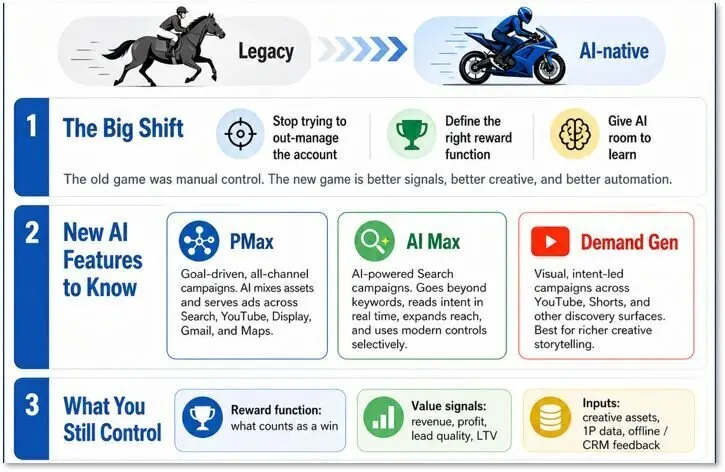
In the modern digital marketing landscape, holding onto manual, keyword-driven search management is the tactical equivalent of riding a horse across the country when long-range, fuel-efficient motorcycles are widely available. Yet, boardrooms and agency floors remain riddled with a stubborn cognitive dissonance. Search marketing is still routinely framed through the archaic lens of brand versus non-brand; marketers continue to monkey with match types, day-parting, geo-modifiers, and negative keyword lists; and traditional agencies still attempt to justify retainer fees by making trivial, high-frequency account tweaks multiple times a day.
This practice is not just outdated—it is profit-pulverizing.
Google Ads has decisively entered its "AIfied" era. Platforms like Google (and Meta) are engineering a reality where human micromanagement actively degrades performance. To achieve superior outcomes, human operators must do less operational grinding while artificial intelligence executes more strategic optimization. Despite this reality, many advertisers remain trapped in legacy habits, treating automated systems as tools to be wrestled with rather than engines to be fueled.
This report provides an investigative look into the modern Google Ads ecosystem, dissects the ongoing paradigm shift from human intervention to algorithmic autonomy, and introduces an authoritative maturity framework designed to drag legacy operators into the present.
Detailed Chronology: The Evolution from Keywords to Intent-First AI
To understand where search marketing stands today, it is essential to trace how the foundational mechanics of digital advertising have inverted over the past decade.
Phase 1: The Mechanized Era (The AdWords Era)
For the better part of twenty years, the holy grail of search marketing was granular human control. Success was defined by how meticulously an operator could sculpt an account. Agencies built massive, hyper-segmented structures like Single Keyword Ad Groups (SKAGs). Marketers obsessively adjusted keyword match types (exact, phrase, broad), engineered manual bidding adjustments based on device, location, and time of day, and spent hours compiling exhaustive negative keyword lists to plug perceived leaks in the funnel.
During this era, human intelligence was the primary bottleneck—and the primary value proposition. Agencies proved their worth by logging into accounts multiple times a day to push manual levers.
Phase 2: The Hybrid Transition (Smart Bidding & Responsive Search)
As query volume exploded and user intent diversified across billions of unique daily searches, human capacity hit a hard ceiling. No human operator could manually analyze signals like browser type, location history, operating system, language, and past click behavior in real time during an auction.
Google responded by introducing machine learning layers: Smart Bidding, Target CPA (tCPA), Target ROAS (tROAS), and Responsive Search Ads (RSAs). During this phase, a friction-filled hybrid period emerged. Marketers begrudgingly adopted automated bidding while continuing to handicap the algorithm by maintaining rigid account structures, choking broad match usage, and fighting the system with manual bid modifiers.
Phase 3: The AI-Native Present (PMax, AI Max, and Demand Gen)
Today, the paradigm has fully inverted. The modern platform architecture relies on three primary AI-native pillars:
- Performance Max (PMax): A unified, cross-channel campaign type where advertisers provide goals, budgets, and creative assets (text, images, video, logos). Google’s AI dynamically mixes and matches these assets to deliver ads across Search, YouTube, Display, Gmail, and Maps based on real-time conversion intent.
- AI Max: Google’s advanced, search-only AI campaign type. It completely abandons traditional keyword constraints, brand/non-brand silos, and rigid match types. Instead, it evaluates live user intent, looking far beyond typed keywords to expand audience reach organically.
- Demand Gen: The evolution of Discovery ads, leveraging AI to assess visual intent and serve immersive video ads, YouTube Shorts, and native feeds across Google’s most engaging properties.
Across all three pillars, the human operator’s role has fundamentally changed: You no longer control the mechanics; you control the reward function.
Supporting Context & Metrics: Decoding the Maturity Model
Moving to an AI-native operational model requires objective self-reflection. To eliminate self-deception—the tendency for marketing teams to overstate their technological sophistication to appease leadership—industry veterans have established quantifiable evaluation metrics.
The Google Ads Maturity Assessment relies on two core vectors: Capability Scoring (evaluating technological sophistication on a 0 to 4 scale) and Depth Scoring (evaluating how widely that capability is deployed across total spend and conversions).
The Capability Scoring Scale
- 0 (Legacy): Manual CPC, heavy device/hour/day bid modifiers, exact-match obsession, SKAG-era structures, and basic proxy metrics (pageviews, sessions).
- 1 (Mostly Legacy with Automation): Basic online conversion tracking exists, but volume-based bidding dominates; slicing campaigns by micro-themes remains common.
- 2 (Hybrid): Macro conversions are cleaner and Enhanced Conversions are live, but value assignment remains crude or incomplete; control-first mindsets persist.
- 3 (Modern): Core non-brand search utilizes Smart Bidding with broad matching logic and RSA-led creative. Revenue or lead-quality values are actively passed back to the platform.
- 4 (AI-Native): Execution default. Bidding is driven by true business value (profit, closed-won LTV), AI Max is leveraged at scale, and human controls are used exclusively for brand governance rather than micromanagement.
The Depth Scoring Scale
To prevent ego from hijacking the audit, depth is evaluated before capability by auditing the top 80% of actual Google ad spend:
- 0: None (0%)
- 1: Pilot only (Under 10%)
- 2: Partial (10%–39%)
- 3: Scaled (40%–74%)
- 4: Execution default (75%–100% coverage)
The Six Dimensions of Google Ads Maturity
The complete assessment measures success across six distinct operational pillars:
- Measurement & Value Architecture (Weight: 30 Points): The foundational layer. If your reward function is flawed, automation optimizes for garbage. Success requires Enhanced Conversions, Data-Driven Attribution (DDA), Offline Conversion Imports (OCI), and Value-Based Bidding tied to revenue or profit.
- Search Operating Model (Weight: 20 Points): Shifting from keyword constriction to AI Max and broad-match governance.
- 1P Data & Audience Intelligence: Activating first-party customer lists, Customer Match, and Data Manager layers to inform machine learning models.
- Surface Breadth & Campaign Mix: Maximizing omnichannel presence through PMax and Demand Gen rather than isolating budget purely within legacy text search.
- Creative & Landing Page Adaptability: Feeding the machine diverse, high-quality asset libraries rather than static, single-ad variations.
- Operating Cadence & Governance: Moving away from daily manual bid tweaks toward strategic governance, asset refreshes, and monitoring business-level KPIs.
A truly modern, AI-fluent organization targets an overall maturity score of 85 or higher, transforming search operations from a time-consuming administrative burden into an automated growth engine.
Official Industry Perspectives: Trust, Pragmatism, and the "Embrace and Extend" Strategy
Transitioning away from legacy campaign structures requires a profound shift in trust. Decades of working within platforms like Google Ads reveal two distinct philosophical biases that define successful modern marketers:
- Institutional Trust in Engineering: Complex platforms are built by elite engineering and product teams. While automated systems occasionally make anomalous decisions—typically explained by Hanlon’s Razor (attributing errors to oversight rather than malice)—they are structurally designed to process millions of hidden behavioral signals that human minds cannot compute.
- Embrace and Extend: Artificial intelligence is not a static tool; it is a learning system that improves daily. Fighting the platform guarantees declining efficiency. The optimal business strategy is to embrace the automated architecture and extend its boundaries through superior data inputs.
As former platform insiders emphasize, the choice to remain in the past is simply not available in a competitive commercial environment. Organizations clinging to manual control are bleeding capital every hour to competitors who allow the machine to learn.
Future Outlook: The New Rules of Engagement
The fundamental equation of digital marketing has been rewritten.
- The Old Game: Can the human out-manage the account? (Answer: No. No human can process multi-signal auction dynamics in real time better than a neural network.)
- The New Game: Can the company feed the machine better truth, better creative assets, better customer value signals, and give it enough room to learn?
The transition away from legacy AdWords habits involves cultural friction, but the payoff is substantial. Organizations that cross the maturity threshold—achieving scores of 70 and above—frequently unlock generational leaps in revenue, profit, and operational efficiency. More importantly, it liberates marketing professionals from soul-crushing, mechanical data entry, elevating them to strategic architects of business growth.
The horse has served its purpose. It is time to start the engine.