
Redefining Aerial Logistics: Inside Airbound’s $37M Quest to Make Drone Delivery Cheaper Than Ground Trucking

Executive Overview
The race to revolutionize modern supply chains has entered a critical new phase, driven by the relentless pursuit of cost parity between aerial logistics and conventional ground transport. In this high-stakes arena, Indian autonomous drone startup Airbound has emerged as a formidable contender. The three-year-old enterprise announced a massive $37 million Series A funding round, bringing its total capital raised to nearly $50 million in a remarkably short span.
The investment round was spearheaded by prominent venture firm Greenoaks, with strategic participation from global delivery giant DoorDash, Silicon Valley investor Lachy Groom, Lightspeed Venture Partners, and Humba Ventures. This latest influx of capital arrives less than a year after Airbound secured an $8.65 million seed round, signaling immense investor confidence in the company’s unconventional engineering philosophy and ambitious scaling roadmap.
At the helm of this enterprise is founder and CEO Naman Pushp. While the broader drone delivery market has long battled issues of scale, payload inefficiency, and prohibitive operational costs, Airbound is tackling these challenges at the foundational level. Rather than simply operating off-the-shelf hardware or modifying existing aircraft types, Airbound is fundamentally redesigning the physics of vertical flight.
The company’s overarching thesis is as simple as it is audacious: to build an autonomous delivery ecosystem where moving goods through the air matches—or even undercuts—the cost of moving them via traditional diesel trucking on congested roads. With a rapidly growing workforce of more than 150 employees, an in-house manufacturing facility in Bengaluru, and major municipal partnerships on the horizon, Airbound is positioning itself not merely as a regional delivery service, but as the foundational aircraft manufacturer—the "Boeing"—for the future global aerial logistics network.
Detailed Chronology: From 2023 Origins to a $50M War Chest
To understand the meteoric trajectory of Airbound, one must examine the timeline of its development, which has moved at a pace rarely seen in the deeply regulated aerospace and logistics sectors.
The Inception (2023)
Founded in 2023, Airbound was born out of a realization that conventional drone technology was fundamentally flawed for mass commercial logistics. Traditional multi-rotor and fixed-wing designs suffer from severe structural inefficiencies: they spend the vast majority of their battery energy lifting their own heavy frames rather than transporting a meaningful cargo payload. Early on, Pushp and his engineering team resolved to flip this paradigm on its head by focusing exclusively on ultralight, highly efficient aircraft architectures capable of carrying payloads heavier than the aircraft itself.
The Seed Milestone (Late 2025)
Following foundational testing and initial prototyping, Airbound hit its first major public milestone by securing an $8.65 million seed round. This capital allowed the startup to transition from a conceptual R&D shop to a structured manufacturing and operational entity. It funded the establishment of a dedicated 43,000-square-foot manufacturing and assembly facility in Bengaluru, where all core airframe development, avionics integration, and propulsion testing are maintained in-house.
The Series A Infusion ($37 Million, 2026)
Cementing its status as a heavyweight in the autonomous logistics sector, Airbound closed its $37 million Series A round led by Greenoaks. Coming on the heels of major real-world deployments—including critical healthcare logistics networks—this capital injection provides the financial runway needed to push beyond regional boundaries. The inclusion of strategic heavyweights like DoorDash underscores global interest in hyper-efficient, last-mile drone delivery technologies that can integrate seamlessly into existing food and retail logistics networks.
Engineering Breakthroughs: Defying the Physics of Flight
The holy grail of drone delivery has always been unit economics. For decades, legacy aerospace companies built aircraft designed for human transport or heavy military applications, downscaling those principles for commercial use. Airbound argues that this top-down approach is fundamentally flawed.
The Weight-to-Payload Paradox
In conventional aircraft engineering, the structural weight of the airframe, motors, batteries, and avionics constitutes the majority of the vehicle’s mass. Consequently, when a drone delivers a small package, most of the electrical energy stored in its battery is wasted just keeping the heavy frame airborne.
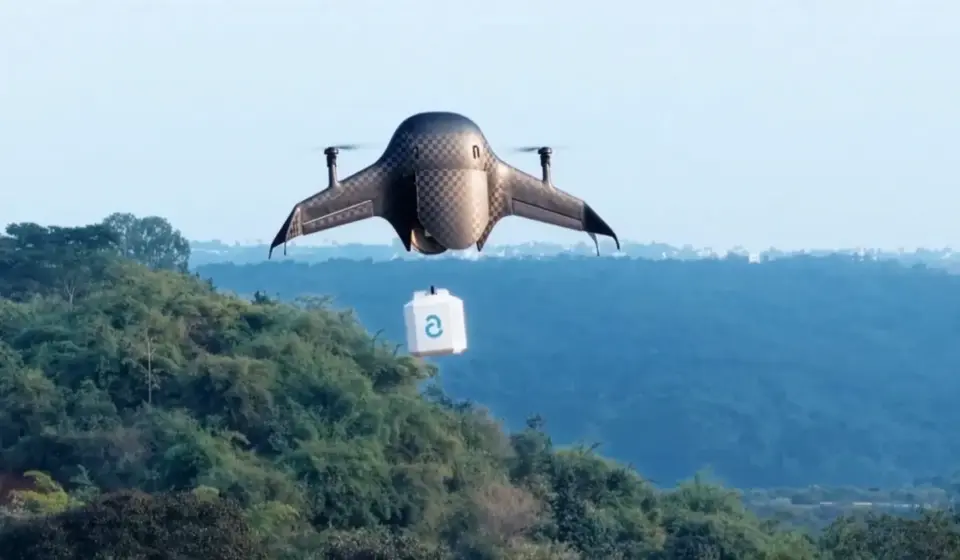
Airbound’s engineering breakthrough centers on designing vertical-flight drones engineered to weigh less than the cargo they carry.
- The Current Iteration (TRT): Airbound’s flagship operational drone, designated the TRT, weighs a mere 3.3 pounds yet boasts a payload capacity of approximately 2.2 pounds.
- The Next-Generation Platform: Currently deep in the development pipeline, the next-generation aircraft is projected to weigh around 6.6 pounds while scaling its carrying capacity up to an impressive 11 pounds.
Rocket-Like, Tail-Sitter Architecture
To achieve this extreme efficiency without sacrificing operational flexibility, Airbound utilizes a rocket-like, tail-sitter design. The aircraft rests and launches vertically in an upright position, eliminating the need for expensive, space-consuming runways or catapult systems.
Once airborne, the aircraft transitions smoothly into horizontal forward flight, maximizing aerodynamic efficiency over longer distances. Pushp has emphasized that even as the company designs larger commercial aircraft for heavier retail and e-commerce loads, it intends to strictly retain this vertical takeoff and landing (VTOL) capability to ensure maximum deployment flexibility in dense urban environments.
Supporting Context, Metrics, and Real-World Deployments
While many drone startups remain confined to controlled testing facilities, Airbound has actively deployed its technology into high-stakes, real-world operational environments.
Healthcare Logistics: The Narayana Health Partnership
Airbound’s most notable proving ground is its ongoing partnership with Indian hospital network Narayana Health across the southern cities of Bengaluru and Guntur. To date, the startup has completed over 13,000 autonomous flights, with more than 1,000 of those dedicated to transporting urgent diagnostic blood samples and medical supplies between healthcare facilities for Narayana Health.
The operational metrics of this route highlight the stark inefficiencies of ground transport:
- Distance: Approximately 2.5 miles.
- Flight Time via Airbound Drone: Roughly 7 minutes using a single active aircraft.
- Truck Transport Time: Between 3 and 5 hours. This massive delay is not caused strictly by road traffic, but rather by the logistical bottleneck of waiting for enough samples to accumulate to justify dispatching a road vehicle.
This partnership is expanding significantly. Narayana Health’s newly inaugurated Banashankari hospital in Bengaluru was purposefully designed without an on-site diagnostic laboratory or blood bank. Instead, the facility relies entirely on Airbound’s autonomous drone corridor to connect instantly with centralized diagnostic labs, effectively redefining modern hospital infrastructure design.
The Three-City Andhra Pradesh Network
Looking past localized medical runs, Airbound has signed a landmark agreement with the state government of Andhra Pradesh to construct a massive, multi-city drone delivery network.
- Scale: The eventual target is an astonishing 10,000 commercial flights per day, servicing retail, e-commerce, and healthcare sectors.
- Fleet Size: Depending on route lengths and density, this network will require between 250 and 1,000 specialized aircraft, with leadership anticipating the operational sweet spot to hover around 250 units.
- Regulatory Framework: Pushp clarified that the agreement does not rely on government subsidies or traditional procurement contracts. Instead, the state government is actively collaborating with Airbound to co-create the regulatory scaffolding required to safely scale high-density, automated aerial corridors.
Official Statements and Industry Perspective
Despite operating in a crowded Indian drone ecosystem that features competing startups like Skye Air Mobility, TSAW Drones, and Garuda Aerospace, Airbound is charting a distinct strategic course.
Rather than attempting to build a consumer-facing delivery brand or wrestling with the razor-thin margins of last-mile delivery operations, Airbound views its identity through an industrial lens.
"We want to build towards a world where everything has cost parity with trucking," CEO Naman Pushp stated during an interview.
Expanding on the company’s long-term commercial identity, Pushp drew a direct comparison to legendary aerospace manufacturing:
"That’s the Boeing role — the aircraft airlines everywhere rely on, not the airline itself."
This manufacturing-first focus is anchored within Airbound’s sprawling 43,000-square-foot facility in Bengaluru. By keeping end-to-end airframe design, structural composites development, and avionics integration entirely in-house, the company aims to immunize itself against the supply chain bottlenecks that traditionally plague hardware startups.
When discussing commercial monetization, Pushp remains refreshingly candid about the long game. Despite boasting a workforce of over 150 skilled engineers and operators, the company remains largely pre-revenue, prioritizing deep engineering refinement and regulatory clearance over premature monetization.
"The goal is to be a giant in a few decades, not to make revenue as soon as we can," Pushp asserted.
Future Outlook and Industry Challenges
As Airbound deploys its newly secured $37 million war chest, the company faces a complex matrix of engineering, economic, and regulatory horizons.
The Regulatory Bottleneck
While Airbound’s manufacturing capacity is well-positioned to scale alongside demand, the company identifies external regulation as its primary operational bottleneck. Specifically, securing widespread regulatory certifications for Beyond Visual Line of Sight (BVLOS) operations remains the critical gating item. Operating commercial drone delivery networks at scale—such as the planned multi-city Andhra Pradesh corridor—is mathematically impossible without robust, automated BVLOS permissions embedded within national civil aviation frameworks.
The Path to Cost Parity
The ultimate test for Airbound over the next five to ten years will be proving that its ultra-lightweight, high-payload design philosophy can achieve true cost parity with diesel trucking on a massive, systemic scale. If the company succeeds, it will not only transform urban and rural logistics across India but export a new paradigm of efficient aerial transport to global markets.
With heavyweight financial backing from Greenoaks and DoorDash, proven operational data from thousands of autonomous medical flights, and an unyielding commitment to manufacturing the foundational aircraft of tomorrow, Airbound is well-equipped to turn the promise of ultra-cheap drone delivery into an everyday reality.