
The Inevitable Pivot: Why Tech’s Biggest Product-Led Companies Are Embracing Sales in the Age of AI

Executive Overview
For over a decade, the software industry’s governing gospel has been product-led growth (PLG). Build a world-class product, drop it onto the internet, optimize the user experience, and let the software sell itself. In this ideological framework, a traditional sales force was viewed as a crutch—a sign that a product lacked the intrinsic viral loop or frictionless usability required to conquer a market organically.
Tech founders wore their aversion to "sales culture" like a badge of honor. Marketing departments were often little more than a charismatic CEO’s Twitter account and a handful of targeted landing pages.
However, a fundamental reckoning is currently sweeping the B2B SaaS and artificial intelligence landscapes. When Replit founder and CEO Amjad Masad recently posted, "I thought I hated sales culture. By the end of this year, more than half my company will be salespeople," it sent shockwaves through the tech community. Masad’s confession was not an isolated outburst; it was the public acknowledgment of a silent, industry-wide shift.
From foundational PLG pioneers like Slack and Atlassian to modern AI giants like Anthropic and Gamma, the trajectory remains remarkably consistent. Freemium and self-serve models do not eliminate the need for a sales team—they merely defer it. Eventually, enterprise procurement, security reviews, and complex multi-million-dollar contracts demand a human touch. As the revenue threshold required to trigger this transition has climbed past $100 million ARR, companies are discovering that scaling without a sales machine is no longer a badge of efficiency—it is a strategic bottleneck.
Detailed Chronology: The Evolution of the PLG-to-Sales Threshold
To understand how we arrived at the current sales renaissance, we must examine how the relationship between product adoption and commercial infrastructure has evolved over the past decade.
The Pre-AI Era: The Rise of "Midwifing" the Sale
At the inaugural SaaStr Annual event in February 2015, a defining panel featured Stewart Butterfield of Slack and David Sacks of Yammer. At the time, Slack was hurtling toward $30 million in Annual Recurring Revenue (ARR) without having hired a single traditional sales representative.
When asked whether a company could reach $100 million without sales, Butterfield offered a nuanced distinction that has aged remarkably well. Slack did not employ salespeople; instead, they had "account managers." There was no cold outbound calling. These account managers interacted exclusively with users who had already decided to adopt the product internally, but whose corporate hierarchies required formal vendor reviews, security policy analysts, and legal sign-offs.
Butterfield famously described this role as "midwifing the sale" rather than traditional selling. Yammer, by contrast, discovered just six to nine months into its lifecycle that selling all-or-nothing, company-wide enterprise networks required human intervention to push deals over the finish line.
The AI Era: The Tripling of the Revenue Threshold
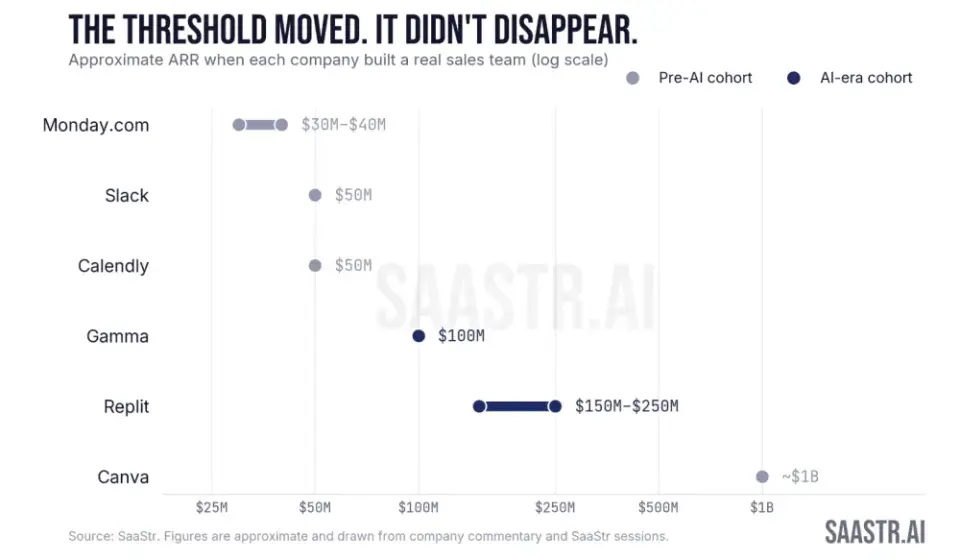
Fast forward to the present day, and the mechanics of this transition have dramatically shifted. In the pre-AI era, companies typically hit the sales wall between $30M and $50M ARR. Today, driven by hyper-efficient bottom-up AI tooling, that threshold has roughly tripled, pushing the breaking point north of $100M ARR.
Consider the trajectory of Gamma. Co-founder and CEO Grant Lee scaled the company to $100 million ARR, 50 million users, and 600,000 paying subscribers with virtually no traditional sales team. Yet, reflecting on the journey, Lee admitted on stage at SaaStr AI: "We’ve always for better or worse been sort of reacting… I would advise maybe not do that." Waiting for inbound demand to become overwhelming is not a growth strategy; it is the absence of one.

Similarly, Lovable scaled to an astonishing $400 million ARR with just 146 full-time employees before actively recruiting a Chief Revenue Officer (CRO) and establishing Go-To-Market (GTM) headquarters in San Francisco and Boston. The pattern is clear: modern AI companies can ride product-led viral loops much further than their predecessors, but the ultimate reckoning with enterprise-grade buyers remains mathematically certain.
Supporting Context & Metrics: What Growth Actually Costs
The economic reality of running a modern software company dictates that spending on go-to-market operations is an unavoidable cost of scale. Analyzing the financial disclosures of public software leaders reveals stark truths about sales and marketing (S&M) expenditures as a percentage of revenue:
- The Consumption Model Ceiling: Companies built on heavy consumption or self-serve models enjoy lower baseline S&M costs. However, even these organizations find themselves pulling back toward industry averages as enterprise customers demand deeper customization and centralized billing.
- The Atlassian Anomaly: For years, Atlassian stood as the ultimate proof that a company could scale globally with virtually no direct sales team, relying instead on a massive network of third-party resellers and channel partners. Yet, recent financial filings tell a fascinating story. Atlassian grew its go-to-market spend by 35.8% year-over-year, outpacing its 26% revenue growth. Even with 85% of the Fortune 500 utilizing its software, Atlassian realized that unconverted demand sitting quietly inside already-won accounts required proactive human cultivation.
- Private Company Realities: According to SaaS Capital’s 15th annual survey of over 1,000 private B2B companies, median spending on selling costs climbed to 15% of ARR, while customer success and support rose to 9%. Crucially, equity-backed companies spend roughly 70% more on sales and 100% more on marketing than bootstrapped counterparts at identical revenue stages. Taking venture capital fundamentally binds a company to the obligation of building a scalable revenue engine.
Furthermore, analyzing headcount distributions reveals a nuanced picture. While Amjad Masad’s declaration that over half of Replit’s workforce will soon be in sales represents an aggressive, early-stage staffing strategy, industry-wide benchmarks show that total GTM headcount (spanning account executives, sales engineers, customer success, and operations) typically settles around 18% of the organization, with the vast majority of capital allocation concentrated in commercial compensation rather than raw personnel counts.
Official Statements and Industry Insights
The transformation of the sales function is receiving validation from executive leadership across the tech ecosystem.
Anthropic on Scaling Commercial Operations:
Eleanor Dorfman, who leads commercial and industries sales at Anthropic, faced a unique operational bottleneck: even if the company had wanted to triple or quadruple its sales force overnight, absorbing talent at that velocity while maintaining a pristine customer experience was practically impossible. By strategically rebuilding its sales organization around AI-native workflows, Anthropic unlocked massive efficiencies. Kelly Loftus, head of startup sales at Anthropic, scaled her team from under 10 to over 150 employees while the overall company expanded from 250 to 1,300 workers in just 18 months. Notably, Loftus revealed a unique philosophy: "We still don’t really have quotas. We have shadow targets." Despite this fluid approach, Anthropic’s aggressive buildout resulted in over 1,000 businesses spending upwards of $1 million annually with the platform.
OpenAI on Agentic Sales Workflows:
The integration of artificial intelligence is fundamentally reshaping internal sales operations. Maggie Hott of OpenAI highlighted a massive organizational milestone during a GTM-wide hackathon focused on rebuilding internal workflows: "Today, 96% of Sales’ work is done with agents."
Emergence Capital and Vercel on Role Compression:
Data from Emergence Capital indicates that while traditional outbound roles like Sales Development Representatives (SDRs) and Business Development Representatives (BDRs) experienced the sharpest headcount contractions (with 36% of companies cutting SDR roles over a 12-year window), technical roles like sales engineers and account executives saw robust growth.
At SaaStr AI, Vercel COO Jeanne DeWitt Grosser shared that deploying an AI lead qualification agent compressed a 10-person qualification team down to just 1.2 people. The human talent was successfully redeployed into higher-value consultative and technical advisory roles. Grosser noted that the modern go-to-market function is rapidly evolving to resemble professional consulting rather than traditional transactional pitching.
Future Outlook: Navigating the Inevitable Transition
For technical founders who harbor an instinctive aversion to sales culture, the data offers three critical lessons for navigating the eventual pivot:
- The First Hire Becomes Harder with Scale: Recruiting a world-class sales leader into a $200 million ARR company with zero existing sales infrastructure, no forecasting discipline, and a founder on record opposing sales culture is exponentially more difficult than hiring at a $5 million ARR startup where the mandate is clearly defined. Delaying the hire compounds organizational debt.
- Infrastructure Debt Compounds Quietly: Clean account data, unified attribution models, and structured CRM pipelines are exponentially cheaper to implement when managing 100 customers than when navigating 100,000 accounts. Deferring the sales build invariably means deferring essential operational plumbing, forcing a messy retrofitting process under severe time constraints.
- Founder-Led Selling is the Essential Catalyst: Founders rarely convert to appreciating sales through theoretical arguments or management books. Conversion happens organically the moment a founder steps onto a plane, makes a direct phone call, and personally rescues a major enterprise deal that would have otherwise fallen through the cracks. Founder-led selling does not scale indefinitely, but it serves as the ultimate masterclass in understanding what real customer objections sound like before handing the reins to a professional revenue leader.
Ultimately, consumer-driven growth can feel like unpredictable weather—you ship code, run multivariate tests, and hope for viral adoption. Enterprise sales, by contrast, is a contact sports discipline where dedicated effort and human execution dictate the outcome. Whether a company embraces a sales team at $30 million or north of $100 million ARR, the underlying truth remains immutable: eventually, almost everyone builds a sales team.