
Bridging the Digital Divide: How Connected Logistics and Composability Are Reshaping Modern Ecommerce Operations

Executive Overview
In the modern landscape of digital commerce, operational failure rarely announces itself with a singular, catastrophic collapse. Instead, it bleeds through the edges of daily business in a hundred invisible paper cuts: a promotional campaign launches, a bestselling product quietly runs out of stock while orders continue to pile up; returns arrive at a warehouse, but inventory counts remain misaligned until a manual audit finally flags the discrepancy; leadership requests a snapshot of live inventory metrics, only for operations teams to spend hours cobbling together fragmented data pulled manually from three distinct administrative dashboards.
These symptoms are rarely indicative of a massive, systemic collapse. Rather, they are manifestations of a pervasive underlying condition: fragmentation.
As order volumes scale, businesses often mistake growing pains for fundamental execution failures. However, the root cause is rarely surging demand; it is a critical lack of cross-system visibility and systemic communication. Simply put, disparate enterprise tools are failing to speak the same operational language.
Fortunately, this digital disconnect is entirely fixable without requiring merchants to undergo costly, disruptive platform rebuilds. By embracing a composable architecture—supported by open ecosystems like WooCommerce—businesses can integrate their core sales channels, inventory management systems, and fulfillment operations into a singular, reliable source of truth. This investigative report examines how modern retailers are breaking down operational silos, navigating the complexities of multi-channel synchronization, and building resilient logistics frameworks designed for sustainable growth.
Detailed Chronology: The Evolution of E-commerce Silos and the Rise of Composability
To understand why modern e-commerce operations struggle with visibility, one must examine how merchants arrived at today’s software stack.
The Monolithic Era
In the early days of scaled web retail, businesses relied heavily on monolithic, all-in-one platforms. These monolithic systems offered a singular way of executing every business process. Because inventory, catalog data, billing, and checkout lived within the exact same software environment, a baseline level of connectivity was preserved by default.
However, this convenience came with a heavy trade-off: a complete forfeiture of operational autonomy. Merchants were forced to accept out-of-the-box workflows whether they suited their unique business models or not. Customizing a monolithic platform often required cumbersome workarounds, expensive proprietary code, and rigid development cycles.

The Rise of Best-of-Breed Fragmentation
As e-commerce matured, merchants rebelled against the constraints of monolithic platforms, giving rise to the "composability" movement. Instead of relying on a single vendor to dictate system architecture, businesses began selecting specialized, best-in-class tools tailored to specific functions—deploying one application for point-of-sale (POS) processing, another for global shipping, and yet another for warehouse management (WMS) or third-party logistics (3PL).
While composability unlocked unprecedented operational flexibility, it inadvertently introduced a new crisis: fragmentation disguised as freedom of choice. Retailers quickly realized that software flexibility does not equate to system visibility. A business might run a state-of-the-art Enterprise Resource Planning (ERP) platform, a specialized shipping application, and an outsourced 3PL warehouse, yet maintain three entirely separate, conflicting inventory counts.
The Modern Integration Imperative
Today, the e-commerce industry stands at a crucial crossroads. Merchants no longer want to choose between the rigidity of monolithic platforms and the blinding chaos of disconnected point solutions. The modern approach focuses on strategic connectivity. By utilizing robust APIs, webhooks, and middleware platforms, merchants can curate a bespoke technology stack tailored precisely to their operational needs while anchoring all systems to a unified operational dashboard.
Supporting Context & Metrics: Diagnosing Your Logistics Health
Before attempting to bridge operational gaps, merchants must accurately assess the true health of their logistics and inventory infrastructure. Industry analysts suggest conducting an internal audit by confronting several critical diagnostic questions:
- Can your team trust inventory numbers without logging into multiple systems? If verifying stock levels requires cross-referencing an e-commerce dashboard with a warehouse app and an ERP spreadsheet, your system lacks a single source of truth.
- When planning weekly restocks, are decisions based on real-time sales data from the last 24 hours, or lagging reports that are days out of date? Supply chain latency invariably leads to stockouts or over-purchasing.
- Who alerts you to fulfillment problems—your internal monitoring tools or your customers? Discovering shipping delays, carrier bottlenecks, or stock discrepancies via customer support tickets indicates an unacceptably slow feedback loop.
- How much human capital is wasted manually copying data between disparate platforms? Manual data entry is not only a drain on labor resources; it is an invitation for human error.
If answering these questions evokes discomfort, it highlights profound underlying issues in system visibility and connectivity. Addressing these vulnerabilities requires systematically linking your e-commerce storefront to the disparate tools handling inventory tracking, sales channels, and fulfillment execution.
Official Insights: Mechanics of Integration and the WooCommerce Framework
Unlike proprietary platforms that attempt to forcefully act as an all-encompassing, monolithic source of truth, open-source frameworks like WooCommerce are designed to integrate seamlessly into a merchant’s broader operational ecosystem. Rather than forcing businesses to adapt to rigid system architectures, WooCommerce connects with existing infrastructure through dedicated extensions, middleware, and custom integrations powered by REST APIs and webhooks.
Technical Implementation: REST APIs and Webhooks
At its core, a robust integration strategy relies on defining three vital components:
- Which system officially "owns" each specific data point (the system of record)?
- What precise event triggers an automated update?
- Where must that update be instantly routed?
WooCommerce simplifies this architecture via its built-in REST API and webhooks. The REST API permits external software environments—such as an ERP or third-party warehouse management tool—to seamlessly read and update store data. Simultaneously, webhooks act as automated digital triggers, instantly notifying external applications whenever an event (such as an order placement, inventory adjustment, or customer refund) occurs within WooCommerce.
For developers or operations managers, establishing these secure connections requires minimal friction. By navigating to Settings > Advanced > REST API within the WooCommerce dashboard, administrators can instantly generate secure API keys and hand them off to external systems. If an ERP or 3PL provider offers a native WooCommerce connector, this simple key exchange represents the extent of the technical setup.
Deep Dive: Four Critical Pillars of E-Commerce Logistics
To build a fully synchronized operation, merchants must systematically connect four foundational pillars of digital commerce:
1. Order Management and Carriers
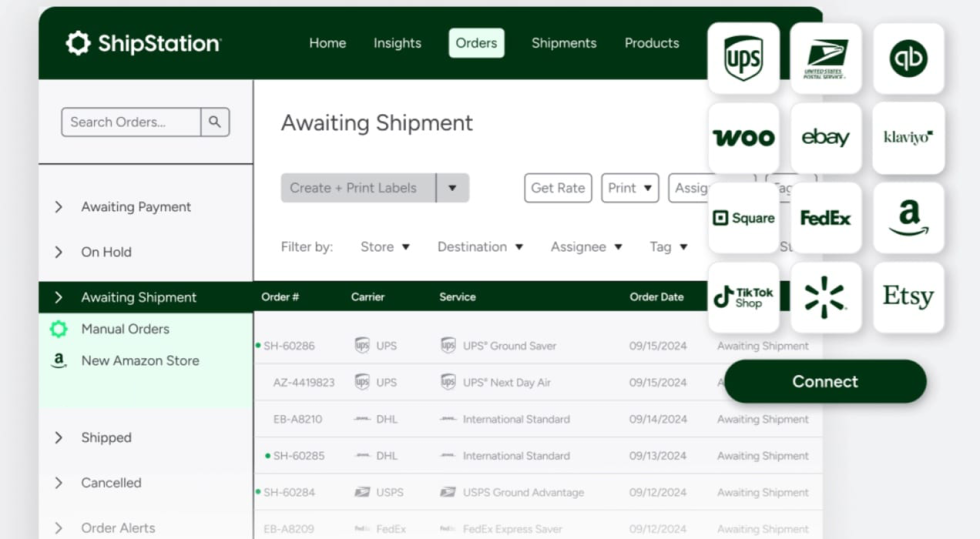
When an online order is placed, manual transcription into carrier portals introduces unnecessary delays and errors. Modern integrations—such as native connections with logistics hubs like ShipStation—automate this journey completely.
- The Automated Flow: WooCommerce Order Created $rightarrow$ ShipStation Processing $rightarrow$ Carrier & Label Generation $rightarrow$ Real-Time Tracking Data Synced Back to WooCommerce $rightarrow$ Customer Notification.
Platforms like WooCommerce also feature specialized shipping extensions that handle tracking generation natively. For instance, utilizing built-in shipping tools allows merchants to purchase postage, automatically generate tracking numbers, and sync those details back to customer accounts instantaneously.
2. Multi-Channel Sales and Inventory Synchronization
Selling across multiple digital and physical touchpoints introduces complex inventory synchronization challenges. Before syncing stock levels across web storefronts, physical retail outlets, and online marketplaces (such as eBay or Walmart), a merchant must explicitly define their primary system of record.
Utilizing integrations like Square for WooCommerce, merchants retain the freedom to designate either platform as the primary product catalog owner. If WooCommerce acts as the source of truth, updates regarding product names, pricing descriptions, and high-resolution imagery flow automatically to Square. Conversely, in-store retail transactions captured via Square’s Point of Sale immediately update inventory levels, which are then mirrored instantly back to the WooCommerce database.
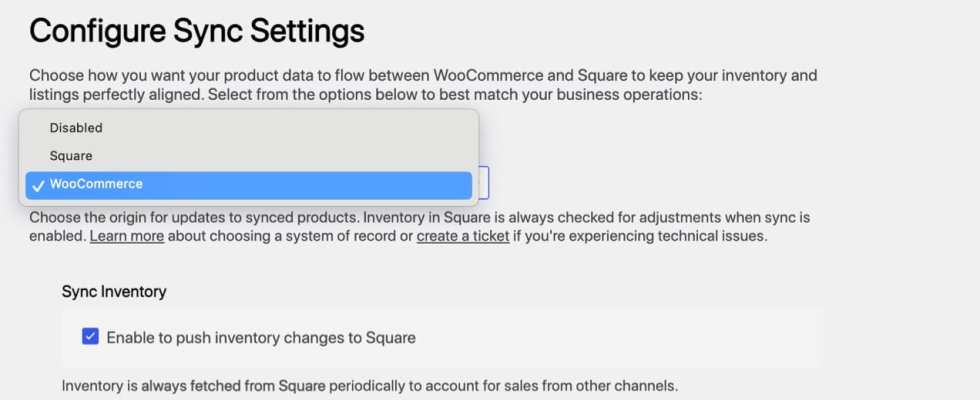
- Catalog Sync: WooCommerce Product Modifications $rightarrow$ Square Catalog Update
- Inventory Sync: In-Store POS Sale $rightarrow$ Square Inventory Deduction $rightarrow$ WooCommerce Stock Adjustment
Crucial Caveat: Integration does not automatically guarantee instantaneous synchronization. For businesses trading high-velocity, limited-quantity inventory across aggressive multi-channel environments, sync frequency and latency must be tightly monitored to prevent overselling.
3. Returns, Reversing Logistics, and Restocking
Reverse logistics require nuanced operational logic because a returned item is rarely immediately available for resale. A healthy returns workflow requires a clearly defined multi-step lifecycle:
- The Return Journey: Return Requested $rightarrow$ Item Physically Received $rightarrow$ Quality Inspection $rightarrow$ Final Disposition (Restocked, Quarantined, or Marked Unsellable).
All participating systems—from customer service portals to warehouse inventory databases—must agree on uniform status definitions. More importantly, businesses must establish which system holds exclusive permission to return an inspected item into the pool of available inventory. Once a warehouse management system (WMS) or 3PL confirms an item is fit for resale, it triggers an API-driven inventory adjustment, restoring stock visibility across all active sales channels.
4. Prioritizing the Integration Roadmap: Where to Begin?
Faced with complex, interconnected logistics ecosystems, many merchants struggle to identify their starting point. Industry experts universally recommend beginning with inventory management.
This prioritization is not because inventory is the simplest component to integrate, but because it is the foundational pillar upon which all other operations rely. Fulfillment tools, multi-channel listings, shipping applications, and outsourced 3PL providers are only as reliable as the accuracy of the inventory data they consume.
The 3PL Challenge: Maintaining Oversight Over Outsourced Fulfillment
Partnering with a Third-Party Logistics (3PL) provider introduces an inherent operational hurdle: your inventory counts physically reside inside a warehouse facility you do not directly control. This structural separation elevates the importance of visibility and mutual trust.
When a 3PL provider operates in isolation without syncing back to a merchant’s core software stack, the business has not solved its logistical fragmentation—it has merely outsourced it to a hidden location.

The ideal integration model ensures that inventory counts, live fulfillment statuses, and return processing pipelines remain fully transparent alongside the rest of the enterprise. Rather than relying on batch updates processed once daily, modern integrations demand real-time synchronization. When an order is successfully shipped, temporarily delayed, flagged as returned, or trapped in customs, that status must reflect instantly across the merchant’s centralized command center.
Fortunately, most enterprise-grade 3PL providers already maintain robust API connectors. Bridging these systems is rarely a matter of custom engineering; rather, it requires configuring the correct data pipelines to eliminate manual workarounds entirely.
Future Outlook: Building a Resilient, Future-Proof E-Commerce Stack
Solving logistical fragmentation does not require businesses to orchestrate a disruptive, company-wide overhaul overnight. The modern commerce ecosystem—exemplified by flexible, open frameworks like WooCommerce—is intentionally engineered to empower merchants to close isolated operational gaps without discarding legacy tools that already drive revenue.
When fulfillment bottlenecks emerge, tools like ShipStation or Shippo can be deployed to instantly compare live carrier rates (USPS, UPS, DHL, FedEx) and generate postage labels directly from a centralized dashboard, effectively eliminating the need to toggle between disconnected carrier portals. For businesses managing multiple warehouse locations, complex global supply chains, and extensive multi-channel storefronts, open APIs and webhook integrations provide the digital glue necessary to bind disparate applications into a unified, high-performing stack.
Ultimately, the future of e-commerce logistics belongs to composability executed with absolute visibility. By deliberately connecting the right software tools around a central, trusted system of record, merchants can build resilient operational stacks tailored precisely to the unique demands of the businesses they run today—securing long-term scalability, operational transparency, and exceptional customer experiences.