
Navigating the Algorithmic Frontier: Why Modern Search Marketing Demands an AI-First Strategy

Executive Overview
In an era defined by high-performance, fuel-efficient motorcycles capable of spanning continents with effortless speed, the choice to rely on a horse for daily transport seems absurd. Yet, this exact analogical disconnect persists across modern corporate boardrooms and digital marketing agencies. Despite years of aggressive platform evolution from digital advertising giants like Google and Meta, a startling number of search marketers and agencies remain shackled to legacy tactics. They continue to spend their days “monkeying” with match types, manual bid modifiers, hyper-segmented geographic blocks, and arbitrary scheduling tweaks—all while making multiple manual interventions a day to prove their operational worth.
This resistance to structural change is more than just outdated; it is profit-pulping. The digital advertising ecosystem has irrevocably shifted into an AI-native paradigm. Platforms are no longer passive registries of keyword demand; they are autonomous, predictive machine-learning engines. To survive and thrive, organizations must abandon the illusion that human micromanagement can consistently outperform real-time, signal-rich algorithms.
By analyzing the architecture of modern Google Ads offerings—such as Performance Max (PMax), AI Max, and Demand Gen—this report outlines why clinging to the AdWords-era playbook is a losing battle. It introduces a comprehensive maturity model designed to benchmark corporate readiness, detailing how to eliminate self-deception, master core dimensions like Measurement Architecture and Search Operating Models, and unlock the exponential revenue gains waiting on the other side of the AI divide.
Detailed Chronology: The Evolution from Manual AdWords to Autonomous AI
To understand where search marketing stands today, it is essential to trace the tectonic shifts that have transformed the discipline over the past two decades.
The Era of Manual Control (The AdWords Paradigm)
For the better part of the 2000s and early 2010s, search engine marketing was characterized by human supremacy over mechanics. Success was dictated by granular campaign structures—often epitomized by the Single Keyword Ad Group (SKAG) methodology—and meticulous manual oversight. Marketers built intricate fortresses of exact-match keywords, adjusted bids down to the device and hour, and spent hours every week pruning search query reports for negative keywords.
In this era, the agency that made the highest volume of daily changes was perceived as the most diligent. Human intuition and spreadsheet discipline were the primary levers of performance. However, this approach was fundamentally limited by the human brain’s inability to process multidimensional auction-time signals simultaneously.
The Hybrid Transition
As machine learning began bleeding into ad platforms around the mid-2010s, marketers were introduced to “Smart Bidding” and early forms of automated targeting. This sparked a decades-long cultural war within marketing departments. Agencies and in-house teams attempted to blend legacy control mechanisms with nascent automation, leading to bloated account structures where machine learning algorithms were perpetually starved of data due to hyper-segmentation. Algorithms were treated as helpful interns rather than the central engine of execution.
The AI-Native Present
Today, the traditional boundaries of search marketing have dissolved. Google and Meta have systematically AIfied their ecosystems. Platforms no longer rely solely on literal keyword strings typed into a search box; they ingest real-time contextual signals, user history, intent patterns, and thousands of weak and strong indicators invisible to human operators.
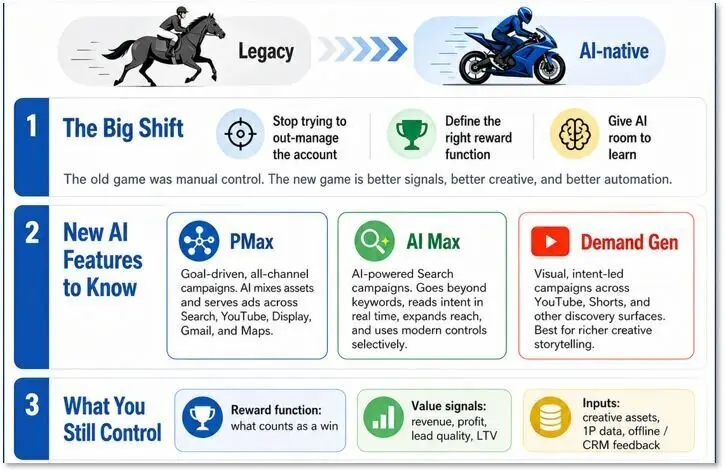
Products like Performance Max, AI Max, and Demand Gen have shifted the marketer’s role from account operator to system architect. The fundamental question has changed: instead of asking, "Can a human out-manage the auction?", modern enterprises must ask, "Are we feeding the machine superior data, higher-quality creative assets, and precise business value signals?"
Supporting Context & Metrics: Decoding Google’s AI Arsenal
To master the current landscape, marketing professionals must understand the architecture of Google’s flagship automated campaign types. These tools are engineered to handle the complexity that humans can no longer efficiently manage.
Performance Max (PMax)
PMax represents Google’s definitive “let us do everything for you everywhere” campaign type. Advertisers provide core business goals, a designated budget, and a diversified asset group comprising text variations, high-resolution imagery, video assets, and brand logos. Google’s neural networks then dynamically mix and match these assets to serve hyper-targeted ads across the entire inventory spectrum: Search, YouTube, Display, Discover, Gmail, and Maps.
AI Max
For brands focused strictly on search inventory, AI Max serves as the natural evolution. Gone are the rigid boundaries of brand versus non-brand segmentation and restrictive match types. AI Max assesses user intent in real-time, looking far beyond the exact words typed into a search query to capture broader, highly relevant consumer intent. It expands audience reach dynamically while deploying modern safeguards like brand exclusion lists and location-of-interest controls.
Demand Gen
Replacing the legacy Discovery campaigns, Demand Gen is a visually immersive, AI-driven format designed to drive action across YouTube, YouTube Shorts, Discover, and Gmail. It leverages advanced predictive intent modeling to surface video and image assets to users most likely to transition from passive viewers to active buyers.
Across all three ecosystems, two foundational principles govern success:
- The Reward Function: Humans retain total control over defining what a "win" looks like. You dictate the business value, conversion definitions, and strategic goals.
- Multidimensional Signal Processing: The AI assesses intent across millions of weak and strong signals—contextual, behavioral, and historical—at a scale that far exceeds human cognitive limits.
While narrow AI applications are not infallible—occasionally stumbling on edge cases—their baseline performance vastly outperforms human operators. Trading three or four algorithm missteps for thirty or forty systemic wins represents an overwhelmingly positive trade-off.
Official Insights & The Maturity Model Framework
Evaluating an organization’s readiness for an AI-first marketing strategy requires objective introspection. To eradicate self-deceptive reporting—where teams inflate their capabilities to appease stakeholders—industry veterans advocate for a structured, mathematical maturity model based on two core dimensions: Capability Scoring and Depth Scoring.
The Two-Dimensional Assessment Matrix
-
Capability Scoring (0 to 4 Scale): Measures the sophistication of the organization’s technical implementation.
0 = Legacy:Archaic manual setups, basic proxies, zero automation.1 = Mostly Legacy with Automation:Basic tracking, heavy manual intervention.2 = Hybrid:Emerging smart features trapped in legacy silo structures.3 = Modern:Core reliance on smart bidding, responsive formats, and broad intent logic.4 = AI-Native:Full utilization of native AI ecosystems with governance-first guardrails.
-
Depth Scoring (0 to 4 Scale): Prevents self-deception by measuring how widespread that sophistication is across total ad spend and conversion volume.
0 = None (0%)1 = Pilot Only (<10%)2 = Partial (10% – 39%)3 = Scaled (40% – 74%)4 = Execution Default (75% – 100%)
Deep Dive: The Six Critical Maturity Dimensions
An enterprise-grade Google Ads maturity model is built upon six foundational pillars. Organizations are measured and scored across these dimensions to generate an overall maturity score, targeting a threshold of 85 or higher.
1. Measurement & Value Architecture (Weight: 30 Points)
If you do not know where you are going, any road will take you there—and you will be miserable at the destination.
Measurement is the bedrock of AI optimization. Because algorithms optimize directly to the reward function they receive, a flawed measurement framework poisons every downstream automated process.
- Key Components: Enhanced conversions for robust first-party data capture, data-driven attribution (DDA) as a default, value-based bidding tied directly to margins or lifetime value (LTV), and centralized offline conversion imports (OCI) via tools like Google’s Data Manager.
- The Contrast: A horse rider optimizes campaigns for cheap traffic, clicks, and vanity metrics like pageviews. A motorcycle rider feeds the algorithm high-fidelity customer value data, allowing the machine to hunt for high-margin buyers.
2. Search Operating Model (Weight: 20 Points)
The modern search operating model relies on Smart Bidding, broad match mechanics, Responsive Search Ads (RSAs), and 100% coverage depth for AI Max where applicable. It discards the obsession with match-type slicing, manual bid modifiers, and hyper-granular keyword structures.
- Key Components: Consolidated account architectures, automated search term matching, final URL expansions, and selective governance controls (such as brand safety lists and location-of-interest parameters).
- The Contrast: A horse rider believes performance is achieved by sculpting accounts daily through manual tweaks. A motorcycle rider simplifies the structure, establishes robust governance, and gives the algorithm the freedom to learn and scale.
3–6. The Extended Architectural Pillars
While Measurement and Search Operations carry the heaviest weights, long-term market dominance requires mastery across four additional dimensions:
- 3. First-Party Data & Audience Intelligence: Leveraging customer match lists and privacy-safe data clean rooms to seed automated algorithms with proprietary buyer profiles.
- 4. Surface Breadth & Campaign Mix: Diversifying presence seamlessly across the entire Google ecosystem through PMax, Demand Gen, and Search integration rather than relying on search text ads alone.
- 5. Creative & Landing Page Adaptability: Feeding algorithms a high-volume, diverse rotation of dynamic assets, videos, and contextually responsive landing pages.
- 6. Operating Cadence & Governance: Shifting agency and in-house team KPIs away from "hours spent making manual changes" toward strategic oversight, asset creation, and business growth auditing.
Future Outlook: The Death of Micromanagement and the Rise of Exponential Growth
The evolution of digital marketing platforms presents a stark ultimatum to the industry. The old paradigm—where competitive advantage was determined by how exhaustively a human could micromanage an advertising account—is dead.
The emerging reality requires a profound cultural transformation. Marketers must relinquish the soul-sucking, low-margin labor of keyword pruning and manual bid adjustments. In its place, they must embrace a higher-order discipline: acting as master architects who feed algorithms superior first-party data, compelling creative assets, and pristine business value signals.
Organizations that make this transition successfully will no longer view AI as a disruptive threat or an unreliable assistant. Instead, they will treat it as a primary scaling engine. Depending on an enterprise’s current maturity score, eliminating legacy workflows and fully embracing the AI-native present unlocks the potential for 3x, 5x, or even 20x increases in revenue and profitability.
The tools are deployed, the maturity frameworks are established, and the path forward is clear. The choice facing every modern enterprise is simple: continue riding the horse of the past, or step onto the highway of the algorithmic future. Carpe diem.