
Conquering Household Chaos: How the Linkdaze Smart Calendar Aims to Disrupt the Family Tech Market

Executive Overview
As the back-to-school season descends upon households worldwide, the perennial struggle of managing colliding schedules, extracurricular activities, professional deadlines, and household chores reaches a fever pitch. For generations, the antidote to this logistical nightmare has been the traditional paper wall calendar—scribbled on, crossed out, and inevitably overwhelmed by the sheer velocity of modern life. While smartphones offer individual organization, they notoriously fail to provide a centralized, ambient view for an entire household.
Enter the smart family calendar market: a rapidly expanding niche of connected touchscreen tablets designed specifically to act as the digital command center for the home. Among the latest contenders making waves in this space is the Linkdaze smart digital calendar. Launched officially last December, Linkdaze has quickly positioned itself as a formidable competitor to established brands like Skylight through a combination of broad platform compatibility, innovative AI-driven features, cost-effective hardware sizing, and a fiercely consumer-friendly no-subscription model.
This comprehensive report examines the technological capabilities, market positioning, competitive landscape, and future implications of the Linkdaze smart calendar. By analyzing its integration ecosystem—including its standout "Snap-to-Sync" AI meal planner—alongside its aggressive pricing strategy in a software-as-a-service (SaaS)-dominated industry, we explore whether this device represents the ultimate solution for domestic management or merely another fleeting gadget in a crowded smart-home ecosystem.
Detailed Chronology and Product Evolution
The journey toward modern domestic organization has evolved rapidly over the past decade, shifting from paper-based planners to fragmented mobile apps, and finally arriving at dedicated ambient hardware.
The Shift Toward Ambient Household Displays
For years, families relied on kitchen whiteboards, sticky notes, and refrigerator-mounted paper planners. While these low-tech solutions offered high visibility, they lacked dynamic updating capabilities. If a soccer practice was rescheduled or a dentist appointment moved, updating the family physical board required manual erasing or rewriting, and those away from home were left entirely out of the loop.
As smart home hubs emerged, tech-savvy households attempted to use smart speakers, shared Google accounts, and tablet wall mounts. However, these setups often proved too complex for younger children or older relatives, leading to fractured adoption rates. Recognizing this usability gap, hardware startups began developing dedicated, wall-mounted touchscreens engineered explicitly for ease of use across multi-generational households.
The Launch of Linkdaze
Entering this competitive landscape in December, Linkdaze debuted with a clear value proposition: bridge the gap between disparate digital calendars used by individual family members and display them in a unified, highly legible format. Available in two distinct form factors—a compact 10.1-inch model and a larger 15.6-inch flagship version—the hardware was engineered to accommodate varying wall space constraints and household sizes.
Since its launch, the device has moved beyond basic time-blocking. Through iterative software updates, Linkdaze has expanded its utility to incorporate household chore tracking, reward systems, interactive grocery lists, meal planning, and ambient digital photo frame functionality. This multifunctionality transforms an ordinary calendar display into an interactive home management hub, mirroring the broader industry trend toward consolidation within smart-home hardware categories.
Technical Architecture and Ecosystem Integration
The true test of any smart home display lies in its interoperability. Families rarely use a single software ecosystem; parents might use corporate Outlook accounts, teenagers may live inside Apple’s iCloud ecosystem, and sports coaches or school administrators often coordinate via Google Calendar or specialized apps like Cozi.
Cross-Platform Synchronization
One of the most significant engineering hurdles for smart calendars is unifying these walled gardens without requiring users to abandon their preferred personal devices. Linkdaze addresses this challenge by building robust synchronization pipelines capable of pulling data simultaneously from major productivity platforms, including:
- Google Calendar
- Apple iCloud
- Microsoft Outlook
- Yahoo Calendar
- Cozi (Dedicated Family Organizer)
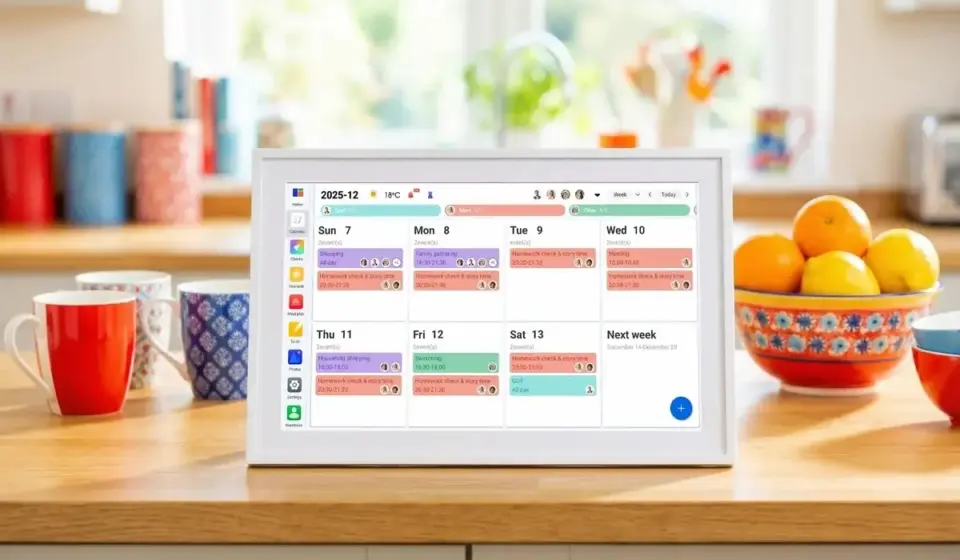
Rather than forcing a household migration to a proprietary app, Linkdaze ingests these diverse data streams and normalizes them onto a single interface. To prevent visual clutter, the system employs an intuitive color-coding architecture, assigning distinct hues to individual family members. A glance at the display immediately reveals who needs to be picked up from soccer, which parent is handling grocery shopping, and what evening commitments overlap.
Hardware Specifications and Form Factors
The physical implementation of the Linkdaze calendar reflects careful consideration of domestic ergonomics. The hardware is offered in two sizes:
- The 10.1-Inch Model: Priced accessibly at $119.99, this unit is ideal for smaller kitchens, tight wall spaces, college dormitories, or home offices where desk real estate is at a premium.
- The 15.6-Inch Model: Designed as the primary wall-mounted command center for larger households, this expansive touchscreen provides optimal legibility from across a busy room, ensuring that even rushing family members absorb critical schedule information at a glance.
Both models feature responsive touchscreens, straightforward user interfaces tailored for users of all technical skill levels, and high-resolution displays capable of pivoting into digital photo frames when not actively displaying schedules.

Supporting Context and Market Metrics: The "Snap-to-Sync" Innovation
Beyond basic time management, the smart display market is increasingly defined by value-add utilities that address daily operational friction points within the home. Among these, meal planning and grocery management rank consistently among the highest domestic stressors.
AI-Driven Meal Planning: "Snap-to-Sync"
To differentiate itself from rudimentary digital calendars, Linkdaze introduced an artificial intelligence-powered feature known as "Snap-to-Sync." Traditionally, digital meal planning required tedious manual data entry—typing ingredients, searching for recipes online, and cross-referencing dietary restrictions.
With "Snap-to-Sync," users can bypass manual typing entirely. By capturing a photograph of a physical recipe torn from a magazine, a handwritten family cookbook page, or a school lunch menu distributed on paper, the Linkdaze system leverages optical character recognition (OCR) and machine learning models to parse the text. The AI automatically translates the visual data into a structured digital meal plan and instantly generates a corresponding shopping list.
While AI-assisted recipe parsing is not an entirely unprecedented concept in the broader consumer tech ecosystem, its seamless integration into a wall-mounted family calendar represents a notable workflow optimization. For busy parents juggling career demands and household logistics, eliminating friction points in meal preparation translates directly to tangible time savings.
The Economics of Smart Home Subscriptions
Perhaps the most strategically disruptive element of the Linkdaze business model is its pricing philosophy regarding recurring software fees. In the contemporary consumer electronics landscape, subscription fatigue has become a pervasive consumer pain point. Hardware manufacturers increasingly rely on Software-as-a-Service (SaaS) models to secure predictable, recurring revenue streams long after the initial device purchase.
For instance, prominent market competitor Skylight locks certain advanced capabilities behind a subscription tier, charging approximately $79 per year for extended features. While this model subsidizes ongoing software development and cloud infrastructure costs for the manufacturer, it often creates consumer hesitation and ongoing ownership friction.
Linkdaze has deliberately chosen a different path, offering its core organizational features without mandating a recurring monthly or annual subscription fee. When evaluated against competing hardware—such as Skylight’s 10-inch model starting at $149.99 when factoring in subscription dependencies, compared to the subscription-free Linkdaze 10.1-inch model at $119.99—the upfront and long-term cost differential becomes stark.
This strategic choice introduces a fascinating test for the smart display market: Will consumers gravitate toward subscription-backed ecosystems supported by continuous cloud feature updates, or will they favor upfront-purchase hardware that promises ongoing utility without recurring financial encumbrances?
Target Demographics and Practical Applications
While marketed primarily as a familial organization tool, the versatility of the Linkdaze smart calendar extends far beyond traditional suburban households.
1. Busy Parents and Large Families
For households managing multiple children across various schools, athletic leagues, and social calendars, the cognitive load of remembering every commitment is immense. By aggregating disparate schedules into a single, color-coded ambient display, Linkdaze mitigates miscommunication, reduces scheduling conflicts, and encourages shared domestic responsibility. Furthermore, features like chore trackers and reward systems provide parents with structural tools to gamify household responsibilities for children.
2. College Apartments and Roommates
Higher education living environments are notorious for logistical friction. Roommates must coordinate shared grocery budgets, cleaning rotations, study schedules, and overlapping social lives. The compact 10.1-inch Linkdaze model serves as an ideal, low-friction communication hub for college apartments, eliminating messy group chats and forgotten household duties.
3. Remote Professionals and Independent Contractors
In an era defined by hybrid work models, freelancing, and side hustles, professionals frequently juggle complex webs of client meetings, interview schedules, project deadlines, and personal appointments. Having a dedicated, persistent visual display of professional obligations separate from personal entertainment devices helps maintain focus and prevents professional burnout.
Future Outlook
As the smart home market matures, devices that solve specific operational friction points rather than offering generalized novelty are best positioned for long-term viability. The success of Linkdaze will ultimately depend on its ability to scale its software ecosystem, maintain robust cloud synchronization across third-party platforms without API disruption, and prove that a subscription-free hardware model can sustainably fund continuous product improvement.
For consumers drowning in paper clutter, conflicting digital apps, and rising subscription costs, products like the Linkdaze smart calendar offer a refreshing glimpse into purposeful technology. Whether deployed in a bustling family kitchen, a lively college apartment, or a home office, ambient digital organization tools are rapidly shifting from futuristic luxuries to modern household essentials.