The recent "Made by Google" hardware and software showcase laid bare a defining truth for modern software architecture: the traditional, single-form-factor application model is effectively obsolete. Unveiled by Fahd Imtiaz, Senior Product Manager, and Product Marketing Managers Loryn Hairston and Tracy Agyemang of the Android Developer ecosystem, the latest tranche of Google hardware—highlighted by the Pixel 11 Pro Fold, the Pixel Watch 5, and the broader integration of on-device artificial intelligence via Gemini Nano 4—signals a structural shift in how users interact with technology.
For developers, this transition represents both an urgent technical mandate and an unprecedented financial opportunity. With foldable device users exhibiting engagement and transaction patterns that significantly outpace standard smartphone users, adapting applications to dynamic display postures, gesture-driven wearables, and edge-native AI is no longer optional. Google’s latest platform guidance, paired with real-world enterprise deployments by companies like Notability, Flo Health, Spotify, and Just Eat, establishes a clear blueprint: building natively adaptive, AI-augmented software without massive code rewrites. This report provides an in-depth, investigative analysis of these platform evolutions, architectural patterns, and the new agentic developer tools designed to accelerate deployment across the entire Android ecosystem.
Detailed Chronology & Technological Breakthroughs
The engineering roadmap presented by the Android team introduces a cohesive triad of upgrades spanning foldables, wearables, and on-device machine intelligence. Each domain is governed by specialized frameworks designed to offload architectural complexity from the developer while maximizing hardware utility.
1. Adaptive Interfaces and Foldable Evolution (Pixel 11 Pro Fold)
The launch of the Pixel 11 Pro Fold forces a fundamental re-evaluation of UI/UX paradigms. Traditional mobile development relied heavily on hardcoded layout dimensions and static screen orientations. Today, developers must design for fluid window spaces that scale gracefully between compact outer displays and expansive inner tablets.
To streamline this transition, Google has introduced advanced Jetpack Compose APIs:
Navigation 3 and Scene Strategies: These APIs allow for dynamic navigation graphs that restructure based on available screen real estate, ensuring smooth transitions between lists, details, and multi-pane views.
Grid and FlexBox Layout Containers: Modern layout primitives that automatically wrap, span, and reflow content, eliminating the fragility of legacy layout hierarchies.
MediaQuery API (Experimental): A powerful primitive that dynamically adapts user interfaces in response to environmental triggers, such as folding postures, hinge angles, and hardware keyboard states.
Furthermore, physical device size is superseded by Window Size Classes from the updated WindowManager library. By tracking true app dimensions rather than hardware parameters, applications can seamlessly navigate split-screen multitasking and window resizing.
State preservation remains paramount during these spatial shifts. By coupling ViewModel architecture with modern Compose state primitives, apps can retain critical user interactions—such as scroll positions, form inputs, and active dialog states—during chaotic configuration changes like folding, unfolding, or rapid rotation.
2. Gesture-Driven Wearables and Wear OS 7 (Pixel Watch 5)
Wearables have moved beyond passive notification mirrors into active, touch-free productivity nodes. Powered by Wear OS 7, the Pixel Watch 5 achieves a 10 percent systemic battery life improvement over its predecessor while introducing sophisticated spatial and contextual interaction models.
One-Handed Gestures Framework: Debuting in the 1.7 beta release of Compose for Wear OS, this framework empowers users to execute complex tasks using single-arm physical inputs—such as a double-pinch or a deliberate wrist turn—entirely eliminating the need for a secondary hand interaction.
Live Updates: Surfacing real-time telemetry (such as live sports scores, workout telemetry, and delivery statuses) directly to the wrist and the Pixel Watch 5 "At-a-Glance" surface. This data can be published locally or bridged securely from a paired mobile device.
Wear Widgets: Built on Jetpack Glance and RemoteCompose, these new widgets replace older Tile frameworks. Offering small (2×1) and large (2×2) layouts that mirror mobile paradigms, Wear Widgets deliver heightened expressiveness and visual consistency across the user’s entire device portfolio.
3. Edge-Native Intelligence via Gemini Nano 4
Cloud-bound artificial intelligence introduces unavoidable latency, security concerns, and offline vulnerabilities. The Pixel 11 hardware family changes the paradigm by embedding Gemini Nano 4 directly onto the device silicon.
Through the ML Kit GenAI Prompt API, developers can issue natural language requests straight to the on-device model. Gemini Nano 4 supports over 140 languages, enhanced multimodal comprehension, and sophisticated features such as:
Structured Output: Enforcing strict schema adherence for programmatic AI responses.
Thinking Mode: Allowing the model to process complex multi-step logical derivations locally before rendering output to the user.
Platform transitions often stall due to perceived engineering overhead. However, early adopters within the Android ecosystem demonstrate that Google’s adaptive guidelines drastically reduce technical debt while accelerating time-to-market.
Notability: Native Fidelity Across Every Aspect Ratio
For note-taking and productivity applications, scaling a digital canvas without distorting user input is a monumental hurdle. Notability integrated Material 3 Window Size Classes to forge a responsive two-pane layout that scales effortlessly between folded and expanded screens.
According to Ryan Shea, Android Engineering Manager at Notability, tracking the window dimensions rather than the device hardware allowed their engineering team to anchor the canvas zoom accurately. This ensures that handwritten notes and typed annotations remain perfectly proportioned through every fold, rotation, and split-screen resize. Shea emphasized that their primary design goal was ensuring Notability felt "native at every size, not just stretched to fit."
Flo Health: Streamlining State Preservation by 30%
As one of the highest-traffic applications on the Android platform, Flo Health faced the daunting task of making intricate user journeys resilient to continuous layout transformations. By implementing Jetpack Compose state primitives, ViewModels, and Window Size Classes, Flo Health fortified its core workflows against folding, unfolding, and screen rotation anomalies.
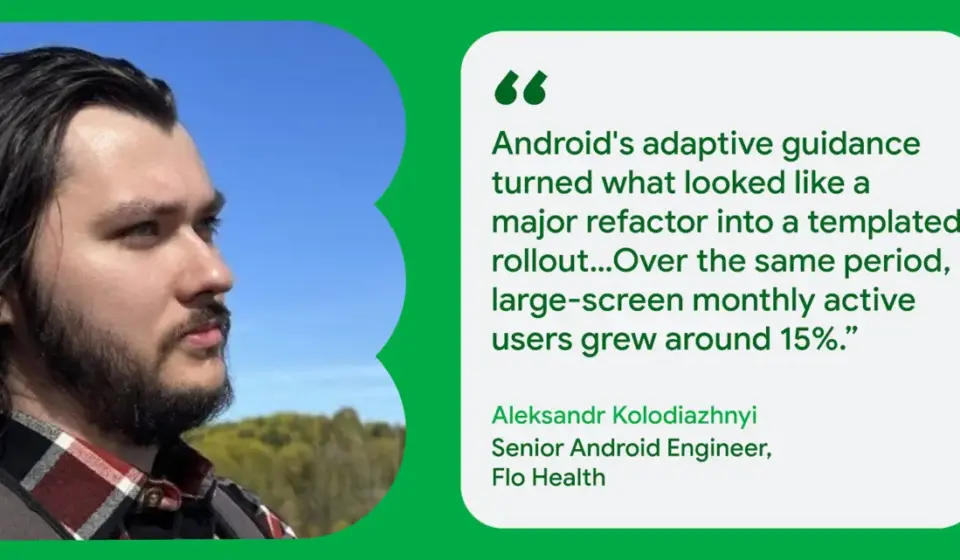
Aleksandr Kolodiazhnyi, Senior Android Engineer at Flo Health, noted that adopting Google’s adaptive guidance converted what initially appeared to be a massive, high-risk application refactor into a structured, templated rollout. Crucially, this transition allowed Flo Health to adopt modern Compose primitives without a complete codebase rewrite, ultimately cutting their state-preservation boilerplate code by approximately 30% while simultaneously correcting persistent lifecycle and analytics telemetry bugs.
Spotify and Just Eat: Wrist-Based Efficiency
Spotify has embraced the Wear OS 7 one-handed gestures framework, directly mapping gesture events—like a double-pinch—to internal media player states. This enables users to pause or resume audio playback seamlessly when their hands are occupied, redefining baseline ergonomics for wearable media control.
Just Eat has integrated Wear OS 7 Live Updates to beam real-time order progression and delivery ETAs directly to the watch face, minimizing friction and keeping users continuously informed without requiring manual app launches.
Official Statements and Developer Guidance
The overarching narrative from Google’s product leadership emphasizes co-evolution: when hardware and software advance in lockstep, the developer community must be equipped with frictionless tooling to bridge the gap.
"Made by Google expands what’s possible across the Android ecosystem… For you, the developer, this represents a massive opportunity: foldable users spend about 14x more than standard phone users. To help you elevate your existing experience without starting from scratch, we’re sharing our latest platform guidance alongside real-world examples from developers already putting these features into production."
To operationalize these capabilities, Google urges engineering teams to leverage established migration pathways:
Camera Architecture: Handling camera previews across foldable posture shifts requires precise management of sensor orientation and display scaling. Migrating to the CameraX library automates these adjustments. For legacy Camera2 codebases, developers can integrate the CameraViewfinder library to achieve robust stability and power dual-screen previewing or high-resolution rear-camera selfies with minimal custom boilerplate logic.
Comprehensive Documentation: Teams can access full platform integration guides and architectural best practices directly via the official portal at developer.android.com/adaptive-apps.
Future Outlook: Agentic Workflows and Android Skills
Perhaps the most forward-looking announcement of the ecosystem update is the introduction of Android skills—a revolutionary approach to developer tooling designed to harness AI agents for rapid implementation.
Complex platform migrations, such as setting up dynamic Compose adaptive layouts or configuring CameraX display scaling across multi-hinge foldables, traditionally demand extensive documentation review and manual trial-and-error. Android skills solve this by providing AI-optimized instructions specifically tailored for autonomous coding agents and developer tools.
Whether utilizing Gemini within Android Studio or executing the Android CLI through external agentic wrappers, developers can now supply their AI tools with rich contextual understanding. For instance, prompting an agent with the official CameraX skill (github.com/android/skills/tree/main/camera/camerax) instructs the model to autonomously handle display scaling across foldable state changes. Similarly, invoking the Adaptive skill (github.com/android/skills/tree/main/jetpack-compose/adaptive) automates the boilerplate configuration of dynamic Compose layouts.
Conclusion
The convergence of the Pixel 11 hardware lineup, Wear OS 7, and on-device Gemini Nano 4 establishes a new gold standard for ambient, intelligent computing. By abandoning legacy assumptions about screen rigidity and embracing modern adaptive frameworks, developers are no longer merely building apps for phones—they are architecting fluid, context-aware digital experiences that span pockets, wrists, and folding canvases. With agentic tooling like Android skills accelerating the path from concept to deployment, the barrier to entry has never been lower, nor the potential reward higher. Developers are encouraged to explore the Android skills GitHub repository and begin shaping the next generation of the Android ecosystem today.