
The New LinkedIn Content Playbook: AI, Collaboration, Creator Marketplace, and Out-of-Network Reach

Executive Overview
The professional networking landscape is undergoing a profound structural shift. As generative artificial intelligence democratizes the mass production of digital content, platforms like LinkedIn are grappling with an unprecedented deluge of low-value, formulaic posts. For modern marketers, brands, and digital creators, the central challenge has evolved from simply maintaining a consistent posting cadence to actively cutting through an increasingly saturated feed.
In response to this modern crisis of attention, LinkedIn has fundamentally updated its algorithm, introduced robust native features, and expanded tools designed to reward original insights, authentic collaboration, and human-first perspective. Based on insights from digital marketing experts AJ Wilcox, Michael Stelzner, and Jerry Potter, this comprehensive playbook explores five critical shifts reshaping the platform: the aggressive crackdown on low-quality "AI slop," the rise of trust-based collaborative posting, the expansion of AI-powered people search, the mechanics of the Creator Marketplace paired with Thought Leader Ads, and the strategic utility of the new Out-of-Network Reach metric.
Mastering these updates is no longer optional; it is the baseline requirement for brands seeking to scale their organic reach and acquire high-value B2B audiences in the current digital ecosystem.
Detailed Chronology & Core Platform Shifts
1: The Crackdown on "AI Slop" and the New Rules of Engagement
For years, LinkedIn actively encouraged users to leverage its built-in generative AI tools to draft posts, polish copy, and accelerate content creation. However, the ecosystem quickly became saturated with homogeneous, predictable, and perspective-free text—a phenomenon the platform and industry insiders now categorize as "AI slop."
To preserve the utility and integrity of the professional feed, LinkedIn has overhauled its distribution matrix. Content flagged as low-quality or lacking a distinct human perspective is systematically restricted, rarely making it beyond the creator’s immediate, existing network. For marketers whose primary objective is top-of-funnel acquisition and out-of-network discovery, this algorithmic penalty is lethal.
The platform is not penalizing AI-assisted workflows wholesale; rather, it is drawing a hard line between efficient drafting and vacuous content. AJ Wilcox notes that the ultimate differentiator is original, current insight—perspectives so fresh and specialized that standard large language models have not yet ingested or synthesized them.
Marketers must shift from relying on AI to generate concepts from scratch to using AI as an editorial consultant. By writing a foundational draft entirely in one’s authentic voice first, creators can subsequently deploy AI to critique logic gaps, sharpen hooks, and polish phrasing. The golden rule is clear: you must remain the active, strategic brain behind every asset published to your profile.
2: Collaborative Posts and the Shift Toward Trust-Based Reach
In an era where any enterprise can instantly generate professional-looking web properties and deploy multiple AI-driven updates daily, traditional corporate broadcasting has lost its efficacy. Trust has become the ultimate currency. To combat plummeting organic reach for corporate company pages—which historically perform poorly—LinkedIn has rolled out native collaborative posts.
Unlike traditional mentions or tags that can be deployed without prior consent, collaborative posts require explicit, mutual opt-in from all participating parties before publication. Once approved, all co-authors are visibly credited at the top of the post.

This mechanism solves two distinct marketing bottlenecks:
- The Employee Advocacy Problem: Instead of forcing employees to awkwardly reshare corporate announcements that inevitably die in the algorithmic ether, brands can co-author posts directly with internal team members, instantly marrying corporate authority with individual personal networks.
- Strategic Cross-Pollination: Brands can partner with non-competing, complementary businesses, industry thought leaders, or external creators to co-create content. Both audiences are merged, creating an expansive ripple effect across adjacent professional communities.
To execute this effectively, brands should initiate outreach with individuals already embedded in their ecosystem—top brand advocates, vocal community commenters, and trusted clients—proposing shared thought leadership topics that deliver mutual value without requiring financial compensation.
3: Optimizing Profiles for AI-Powered People Search
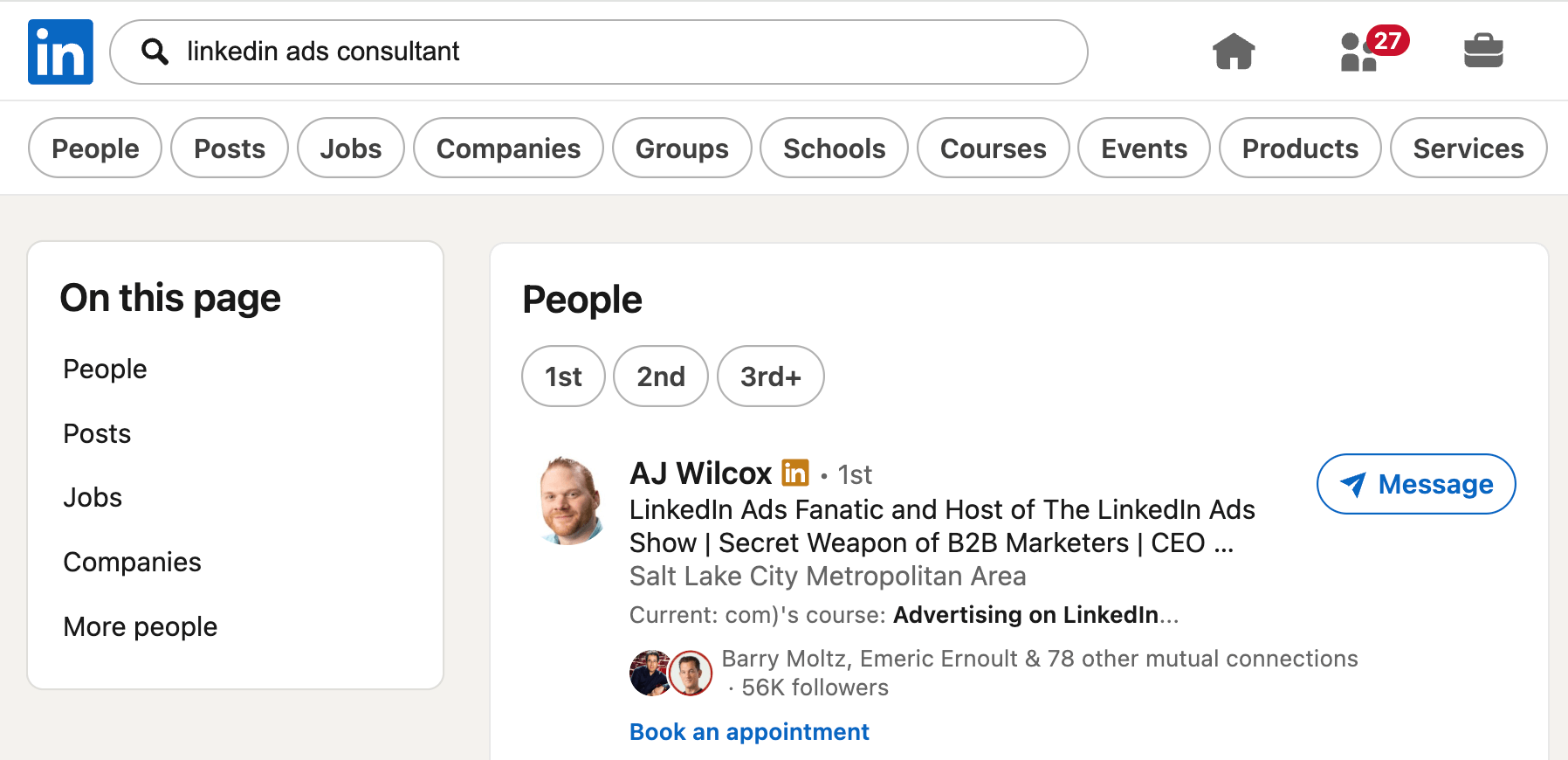
LinkedIn has officially expanded its natural-language, AI-powered people search infrastructure to all US users, lifting previous premium-only restrictions. This development marks a seismic shift away from traditional, keyword-stuffed profile optimization toward intent-driven, conversational search algorithms.
Users can now search the platform using natural phrasing to identify professionals based on complex criteria, situational needs, and nuanced intent. Furthermore, AI-generated profile summaries now appear dynamically in search results, complete with verification badges that function as immediate trust signals. These summaries distill a professional’s background, highlighting shared connections, mutual experiences, and core competencies.
Consequently, profile optimization has effectively become the new Search Engine Optimization (SEO). Professionals and executives can no longer rely on rigid HR-approved buzzwords. Instead, profiles must be crafted in clear, authoritative, and natural language that advanced AI models can accurately parse, summarize, and rank.
4: The Creator Marketplace and Thought Leader Ads
The launch of LinkedIn’s Creator Marketplace inside Campaign Manager has fundamentally streamlined how B2B brands discover, evaluate, and partner with independent creators. By surfacing creators who have organically mentioned a brand in past content, the marketplace bridges a persistent gap for marketing teams struggling to secure executive buy-in for content creation.
Simultaneously, LinkedIn’s Thought Leader Ads have emerged as one of the most cost-effective paid media units on the platform. By applying paid advertising dollars behind an individual’s organic post, brands gain access to hyper-targeted audiences while retaining the authentic social proof of the original creator.
For creators looking to capture lucrative brand partnerships, the pathway is straightforward:
- Strategic Mentions: Mention target brands organically in posts. To ensure visibility, tag specific marketing or partnership personnel rather than general company pages, which often suffer from notification fatigue.
- Deep-Dive Content: Publish rigorous, public analytical breakdowns or strategic reviews of a target brand’s industry positioning. This showcases tangible competence to the brand while simultaneously building equity with the creator’s native audience.
- Amplification Arbitrage: Creators can partner with brands to sponsor their own posts, leveraging low-cost advertising impressions (CPMs) to guarantee metrics like 100,000 views, transforming a modest ad spend into a massive portfolio asset.
5: Mastering the Out-of-Network Reach Metric
Evaluating content performance has traditionally relied on vanity metrics such as total views, generic comments, and surface-level reactions. To provide deeper strategic clarity, LinkedIn has introduced a transformative post-analytics metric: Out-of-Network Reach.
This metric explicitly segments impressions, revealing the exact percentage of viewers who are not existing connections or followers versus those within the immediate network. For smaller accounts or emerging creators, this metric serves as vital validation, proving that algorithmic recommendations, search indexing, and organic reshares are successfully pulling new eyes onto the profile.
Content strategists can use this metric as an empirical feedback loop. By systematically tracking which topics, formats, and angles consistently breach the out-of-network threshold, marketers can refine their editorial calendar, double down on high-travel concepts, and systematically expand their addressable market.
Supporting Context & Strategic Metrics
To contextualize the scale of these platform changes, consider the following operational data points gathered from industry benchmarks:
- The Ad Efficiency Gap: While organic corporate page updates frequently struggle to surpass low single-digit engagement rates, Thought Leader Ads yield significantly higher click-through and engagement rates compared to traditional, cold-branded display ads.
- Micro-Targeting Thresholds: LinkedIn ad architecture allows hyper-specific targeting parameters down to enterprise employee lists with minimum audience thresholds of just 300 individuals, making niche account-based marketing (ABM) campaigns highly cost-effective at high-end CPMs of approximately $80.
- The Trust Economy: Peer-driven insights and collaborative multi-author posts consistently outperform single-source corporate broadcasts in algorithmic distribution, reinforcing the platform’s pivot toward human-centric thought leadership.
Future Outlook
As LinkedIn continues to refine its ecosystem through sophisticated artificial intelligence and strict content governance, the era of frictionless, automated mass-posting on the platform is officially over.
Marketers and creators who successfully adapt to this new playbook will thrive by embracing a hybrid operational model: utilizing AI strictly as an efficiency tool for structural polish, prioritizing human-first original insights, forging strategic alliances through collaborative publishing, and leveraging paid amplification via the Creator Marketplace. Those who fail to adapt and persist in flooding the feed with formulaic, low-perspective content will find themselves increasingly sequestered within dwindling, isolated networks.
The future of professional visibility belongs entirely to those who treat authenticity, strategic collaboration, and genuine thought leadership as non-negotiable core assets.