

Bridging the GTM Divide: Why 87% of SMB Teams Are Struggling with Sales and Marketing Alignment—and How to Fix It

By Josh Gallant | Updated July 21, 2026
Executive Overview
Sales and marketing misalignment rarely presents itself as a clear, easily solvable strategy problem. Instead, it masks itself as operational noise: "qualified" leads generated by marketing that sales professionals flatly refuse to trust; marketing campaign messaging that sales reps know nothing about until a prospect quotes it back to them; and a pipeline that looks healthy on the surface until closed revenue begins to quietly stall.
To uncover what is truly happening inside small-to-medium-sized business (SMB) go-to-market (GTM) teams, Unbounce surveyed over 500 SMB GTM professionals for their comprehensive 2026 report, The Anatomy of Aligned Go-to-Market Teams.
The headline findings are stark: 87% of teams expect better sales and marketing alignment to directly lift performance, yet only 56% describe themselves as highly aligned.
This persistent gap highlights a deeper systemic issue. Most organizations attempt to solve strategic fragmentation with superficial fixes—namely, more meetings. However, data from the report reveals that true alignment cannot be achieved through calendar invites alone. It requires fundamental restructuring of data ecosystems, tech stacks, lead qualification rules, and incentive models.
Detailed Chronology: The Anatomy of a Misaligned Pipeline
To understand how modern GTM teams fall out of sync, one must examine how friction compounds over the lifecycle of a typical customer acquisition cycle. Misalignment rarely starts as a catastrophic failure; rather, it is a slow accumulation of small operational fractures.

Phase 1: Upstream Divergence (The Persona Gap)
The breakdown typically begins before a campaign even launches. Marketing and sales operate on divergent definitions of who the ideal customer actually is. While marketing focuses on broad volume and top-of-funnel indicators (traffic, raw lead counts, and form fills), sales is hyper-focused on account fit, budget availability, and decision-maker access.
Without a shared, cross-functional buyer persona established from day one, marketing builds campaigns targeting phantom profiles. Consequently, when those leads reach sales, they are immediately dismissed as unqualified, setting off a cycle of mutual finger-pointing.
Phase 2: The Handoff Breakdown
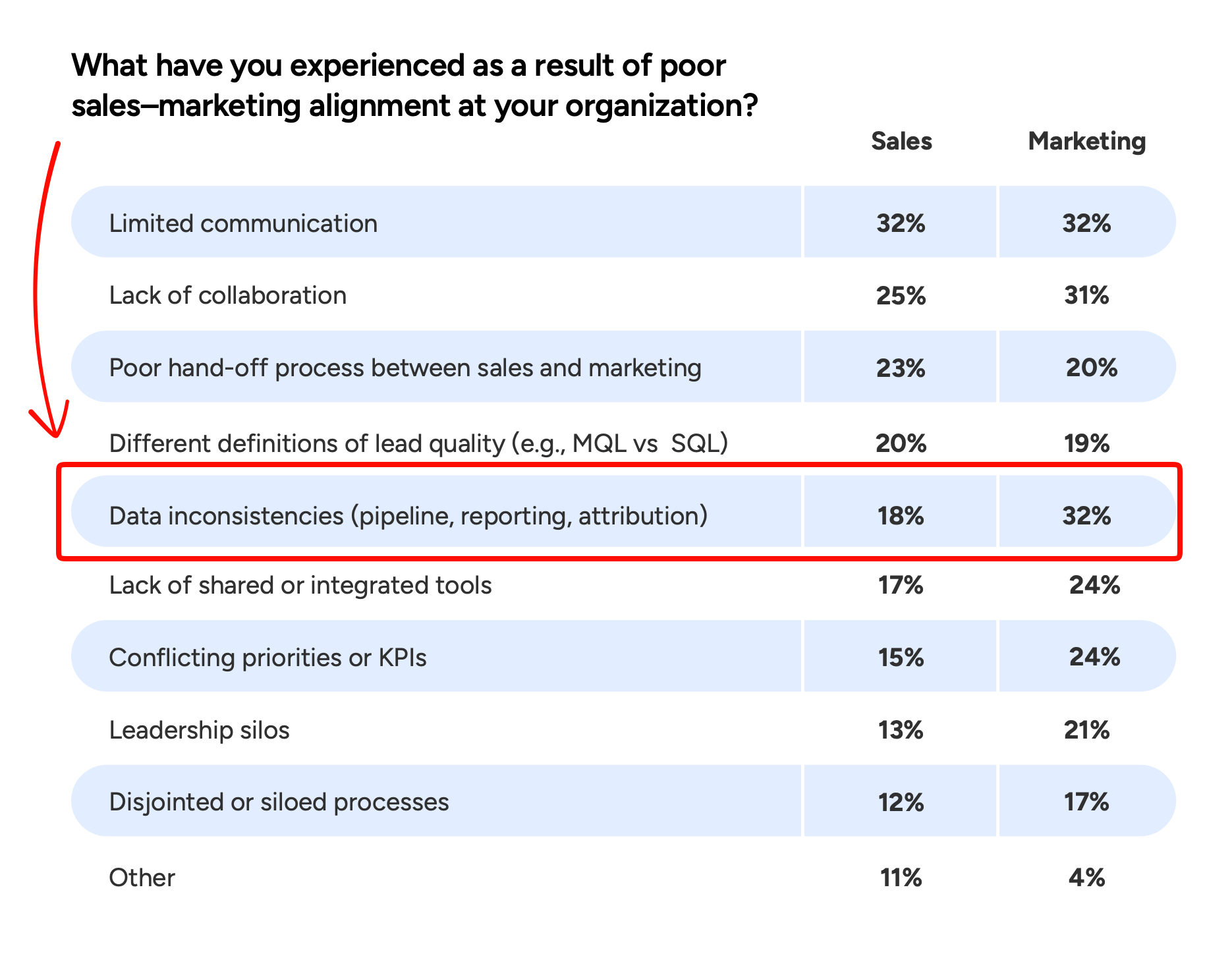
Once a lead is captured, it enters the handoff zone—the most vulnerable operational bottleneck in the entire GTM funnel. According to the data, 23% of sales professionals cite a poor handoff process as a primary alignment barrier.
Without a rigorous Service Level Agreement (SLA) defining what data must accompany a lead, when it must be transferred, and how quickly sales is obligated to follow up, leads slip through the cracks. Marketers report that their carefully nurtured leads sit untouched in the CRM, while sales reps complain that the context provided is utterly useless for a discovery call.
Phase 3: The Reporting Divergence
As leads progress—or fail to progress—toward closed-won status, the reporting mechanism shatters. Marketing evaluates success through attribution models, digital touchpoints, and Marketing Qualified Lead (MQL) velocity. Sales measures success via pipeline value, deal stages, and closed revenue.
Because both departments pull data from different sources or interpret shared dashboards through partisan lenses, they arrive at leadership meetings with conflicting explanations for why quarterly targets were missed.

Supporting Context & Metrics: What the Data Reveals
A deeper dive into the numbers from Unbounce’s 2026 report illuminates the scale of the challenge and exposes the stark perception gaps dividing leadership from individual contributors.
The Perception Gap: Executives vs. The Front Lines
One of the most revealing findings in the study is the massive disconnect in how alignment is perceived across organizational tiers:
- 69% of executives report strong sales and marketing alignment.
- Only 47% of non-executives agree with that assessment.
Furthermore, departmental loyalties skew perspectives further: 62% of sales professionals feel highly aligned, compared to just 53% of marketers. Why does the view from the top look so rosy while the ground-level reality is chaotic?
Executives tend to evaluate alignment through the lens of high-level strategy decks and recurring leadership syncs. Non-executives, however, experience alignment through operational barriers: data inconsistencies (cited by 28% of non-execs vs. 22% of execs), limited communication (33% vs. 28%), and deep-seated leadership silos (19% vs. 14%).
The Financial and Cultural Cost of Misalignment
When alignment breaks down, the cost is rarely absorbed quietly. It manifests as severe cultural friction and wasted capital:
- Employee Frustration (29%): Operational friction is the leading human cost, leading to burnout, high turnover, and apathy.
- Delayed Follow-Up (28%): Sluggish handoffs waste hard-earned ad spend and allow competitors to swoop in.
- Duplicated Work (26%): Teams waste countless hours recreating assets, lists, and strategies because information is not shared.
Marketers feel these consequences most acutely: 32% flag delayed follow-up as a major issue (compared to 22% of sales reps), and 29% cite unclear target customer profiles as a bottleneck (compared to just 16% of sales professionals).
The Tool Bloat Trap
When companies experience pipeline friction, their default reaction is often to purchase new software. However, the data indicates that tool bloat is actually a primary driver of misalignment:
- 56% of GTM professionals admit that tool bloat is a significant issue at their organization.
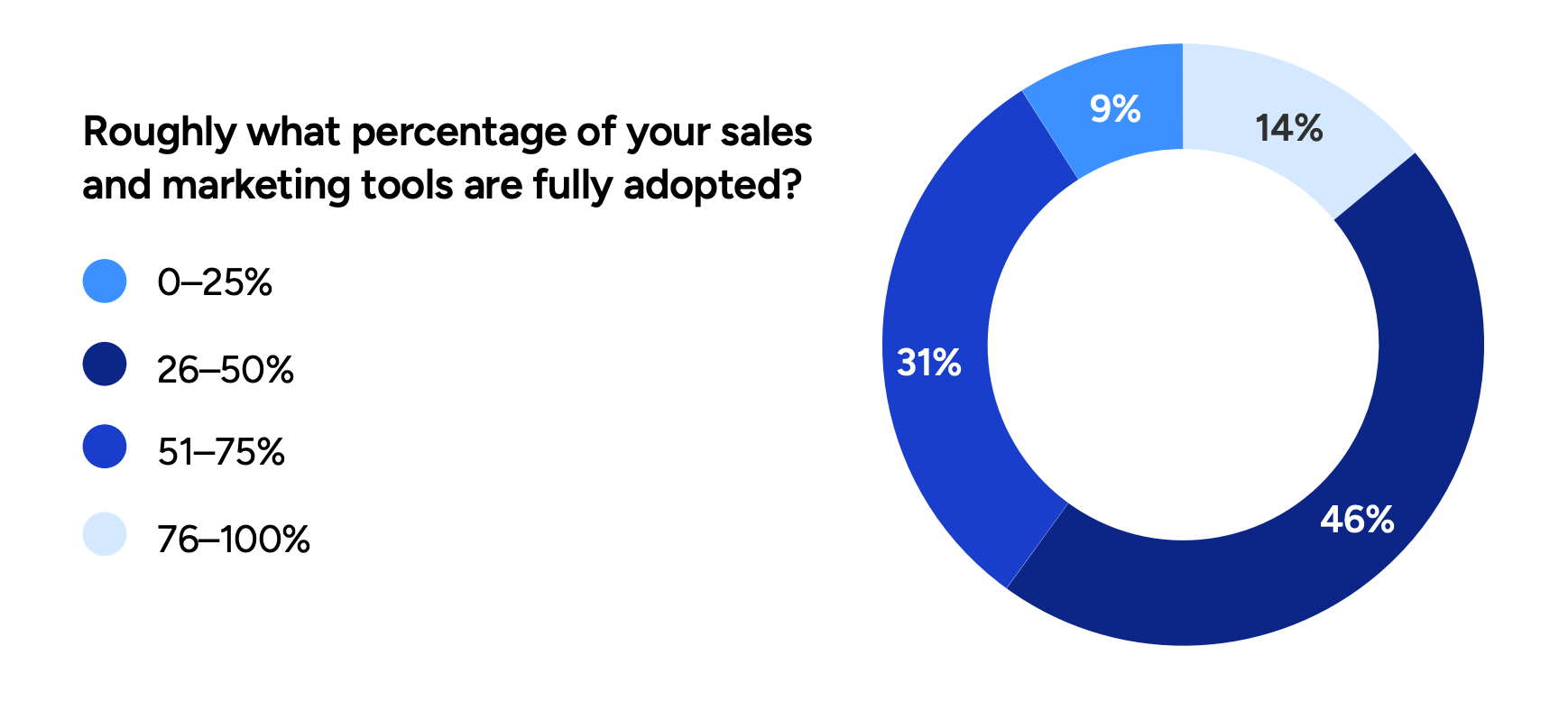
- 60% of teams use less than half of their available tech stack.
- 14% of teams utilize 0% to 25% of their tools, while 46% utilize only 26% to 50%.
Conversely, organizations that actively consolidated their tech stacks are 2x more likely to rate lead quality as "excellent" (55% vs. 20%). Leaner, highly adopted tool suites consistently outperform sprawling, disconnected technology ecosystems.
Official Statements and Industry Insights
Industry leaders and operational experts agree that solving alignment requires moving past the illusion of communication.
"Sales and marketing alignment is rarely a communication failure; it is an operating model failure," notes Josh Gallant, founder of Backstage SEO and author of the report. "Too many organizations believe that scheduling another weekly sync call will fix a broken pipeline. In reality, meetings only broadcast the dysfunction that is already baked into your data models and incentive structures."
Data integrity remains a massive hurdle. While 40% of GTM teams report excellent cross-functional data sharing, 68% simultaneously encounter regular data inconsistencies. This paradox highlights that while teams may have access to the same software, they are interpreting disparate data streams.
Marketing relies heavily on centralized attribution and digital engagement metrics, whereas sales operates on localized pipeline signals and CRM notes. Until these data sets are unified under a single source of truth, cross-functional harmony will remain out of reach.
Future Outlook: The Path Forward for Aligned GTM Teams
Organizations looking to bridge the gap between sales and marketing over the next 12 to 24 months must transition from treating alignment as an interpersonal goal to implementing structured, operational reforms.
1. Unified Buyer Personas and Shared Lead Definitions
Alignment must begin at the top of the funnel. Buyer personas should never be created in a marketing vacuum; they must be forged as joint artifacts incorporating real-world sales call insights, customer objections, and behavioral qualifiers. Furthermore, the definition of an MQL and an SQL must be formally codified in a shared SLA to eliminate subjective debates over lead quality.
2. Operationalizing the Handoff
With 36% of GTM teams pointing to lead qualification and handoff processes as the single most impactful area for improvement, organizations must build ironclad routing rules. A functional handoff requires three non-negotiable elements:
- Clear enrichment data: Comprehensive context regarding prospect behavior, intent signals, and historical campaign touchpoints.
- Defined SLAs: Strict timeframes for initial sales outreach.
- Automated feedback loops: Mechanisms within the CRM that instantly notify marketing of lead status changes (e.g., why an MQL was disqualified).
3. Consolidating the Tech Stack and Integrating Data
To eradicate siloed data, forward-thinking SMBs are heavily prioritizing data integration and analytics infrastructure. According to the report, 44% of GTM teams are prioritizing data integration and AI-driven insights for upcoming technology investments. By centralizing data into unified CRMs and landing page optimization platforms, teams can finally measure success against shared KPIs—such as Customer Acquisition Cost (CAC) and blended conversion rates—rather than isolated departmental metrics.
Ultimately, bridging the GTM divide demands discipline. By replacing bloated tech stacks with streamlined workflows, aligning financial incentives with shared revenue goals, and establishing an undeniable single source of truth, SMBs can transform their go-to-market engine from a source of internal friction into a scalable, high-performing revenue machine.